The failure mode isn't what we think it is
When something goes wrong at a company — Enron, Volkswagen's emissions scandal, take your pick — the post-mortem almost always points up. Bad leadership. Toxic culture from the top. Rarely does it point sideways, to the rooms full of people who saw the problem and said nothing.
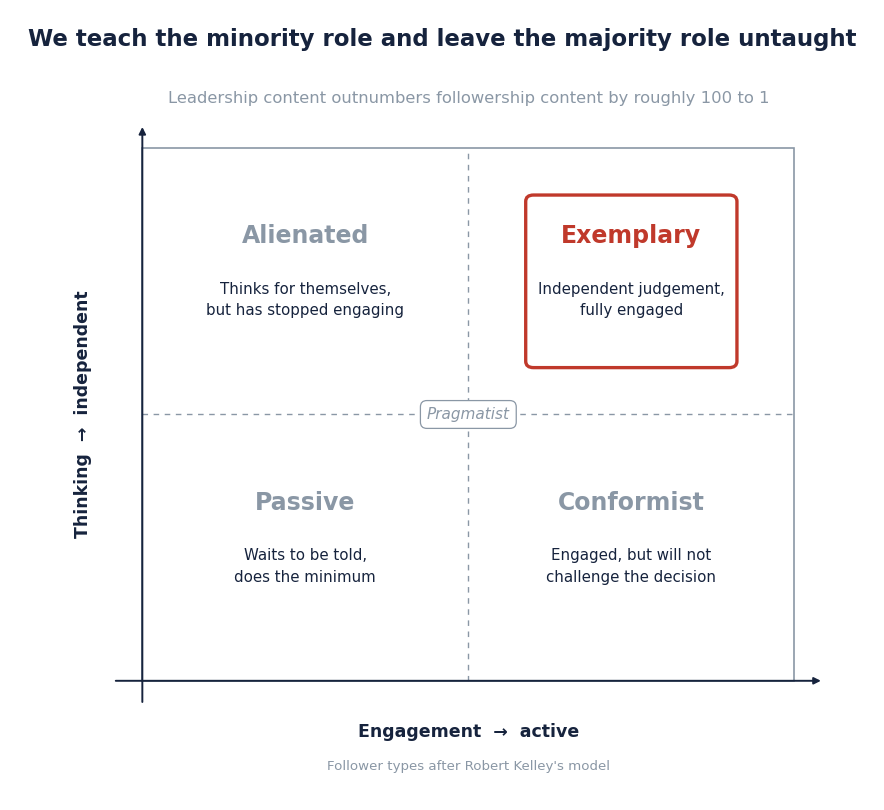
That's not only a leadership failure but also a followership failure — silence, compliance, normalized dysfunction. Robert Kelley, who did the foundational research on this in the 1980s and 90s, mapped followers on two axes: independent vs. dependent thinking, and active vs. passive engagement. The followers who matter most — his "exemplary" type — aren't the ones who do what they're told. They're the ones who stay engaged and think critically enough to push back when something's wrong.
Why the imbalance persists
Nobody wants to write the bestseller titled How to Follow Better. Followership sounds like it's teaching subordination, even though the actual content — constructive dissent, sound judgment, engaged execution — is the opposite of submissive. Leadership is more flattering to teach and easier to sell. So we keep pouring resources into the top of the org chart and hoping the rest sorts itself out.
There's a fair counterpoint here: leadership does carry outsized structural leverage. One bad call at the top can outweigh a hundred good followership decisions below it. Some asymmetry in attention is earned, not just bias. But "leadership matters more" and "followership is dramatically undertaught relative to its actual weight in outcomes" are both true at once.
What this means if you're building a team
- Stop hiring only for leadership potential. Ask how a candidate has followed — what they did when they disagreed with a decision they didn't own.
- Reward voice, not just output. If the people closest to a problem never speak up, that's a structural signal, not a personality trait.
- Watch for "alienated" followers before you lose them. Kelley's research shows today's cynical, checked-out employee is often yesterday's exemplary one who got burned for speaking up once too often.
- Measure it, even imperfectly. There's no clean instrument for this yet — no Big Five for followership — but constructive dissent rate, delegation trust, and voice-to-silence ratio in meetings are workable proxies.
Every seat I fill is, at some level, a followership hire before it's a leadership one — someone who will follow a new boss, a new culture, a new set of unwritten rules. We evaluate almost none of that on purpose. We should.