Takeaway 1: The ban on lethal arms exports is gone
On 21 April 2026 the cabinet revised the Three Principles on Transfer of Defense Equipment and Technology — the framework that had kept Japanese industry out of the weapons market in some form since 1967.
The five permitted non-combat categories (rescue, transport, warning, surveillance, minesweeping) were scrapped and replaced with a simple split between weapons and non-weapons. Lethal equipment can now be exported, in principle, to the 18 countries holding a defense-transfer agreement with Japan.
One detail is widely misreported: oversight did not tighten. Weapons exports no longer require prior Diet approval. The National Security Council decides, and the Diet is informed afterwards. Takaichi still describes Japan as a pacifist nation and points to NSC review and end-use monitoring as the safeguards. The practical effect was to move the decision out of parliament and into the cabinet.
Four months on, this is no longer theoretical.
- 18 April. Mitsubishi Heavy Industries contracted with Australia for up to 11 upgraded Mogami-class frigates, around A$10bn (roughly US$6.5bn). The largest Japanese warship export in modern history. The first three hulls are built in Japan, the remaining eight in Western Australia with Austal, first delivery 2029.
- 7 May. Defense Minister Shinjiro Koizumi and Philippine Secretary Gilberto Teodoro agreed a framework for transferring used Maritime Self-Defense Force destroyers. By 7 July, Manila confirmed five Abukuma-class destroyer escorts under Official Security Assistance.
- 5 June. Tokyo and Jakarta opened talks on heavier, air-defense-capable Asagiri-class hulls, packaged with training and maintenance.
Read the three together and the strategy is clear. Japan is matching hull class to each buyer's threat profile and tying every recipient into a Japanese maintenance chain. Industrial scale lowers unit costs for the Self-Defense Forces; the contracts embed Japan in its partners' defense planning for thirty years.
Takeaway 2: Sanaenomics, and what the bond market makes of it
Takaichi's fiscal programme is a deliberate break from Abenomics, which was repeatedly undercut by badly timed consumption tax increases. She is running what she calls a high-pressure economy instead: a ¥21.3 trillion stimulus package, about 3.7% of GDP, with ¥17.7 trillion in direct spending.
Three pillars: the cost-of-living squeeze, state-backed investment in AI and semiconductors, and national security and supply-chain resilience. Some ¥6.4 trillion is earmarked for semiconductors, AI and defense, alongside a two-year suspension of the consumption tax on food.
The most interesting item is the smallest. The 1.03-million-yen barrier (年収の壁) — an income tax deduction threshold frozen since 1995 that discourages part-time workers, mostly women, from taking more hours — is finally targeted for reform. If you staff retail, hospitality or manufacturing in Japan, that matters more to you than the headline stimulus does.
On foreign labour the direction has reversed, and this is where commentary is most out of date. Takaichi was initially read as a pragmatist on immigration. She is not.
- The new 育成就労 status (Employment for Skill Development), which replaces the Technical Intern Training Program (技能実習) in FY2027, is planned to be capped at around 426,000 for its first two years.
- The Specified Skilled Worker Type 1 (特定技能) ceiling has been cut to 805,700, from the 820,000 set in 2024.
- Enforcement against visa overstayers has been stepped up on her instruction.
The 1.23 million aggregate intake target survives, so this is a cap rather than a closure. But an aggregate target and a first-cohort ceiling are different instruments, and it is the ceiling that decides whether an intake actually clears. Conservative nationalist politics won this argument outright.
Then the market's verdict. The Bank of Japan raised its policy rate to 1.0% in June and held there on 31 July by an 8–1 vote, signalling a possible move as early as September. It expects core inflation to run clearly above its 2% target from the second half of the fiscal year. The yen touched ¥163.99 to the dollar, its weakest since the mid-1980s.
Growth has not kept pace. Second-quarter GDP grew 0.3% on the quarter — 1.1% annualised, against a 2.0% consensus. Private consumption was flat, capital expenditure fell 1.2%, and only external demand kept the quarter positive.
The inflation arrived. The economy has not yet.
Takeaway 3: The alliance is transactional now, and it has a price
The Takaichi Doctrine is as much a response to Washington as to Beijing. Tokyo has concluded that values-based alliances are not sufficient in a transactional age — a view shaped by the memory of the 1985 Plaza Accord and by persistent talk of a new Mar-a-Lago Agreement.
The 19 March summit with President Trump proved the point by omission. It produced no breakthrough; its success was the absence of a rupture. Japan announced participation in the Golden Dome missile-defense initiative, and both sides reaffirmed cooperation on supply chains, deterrence, AI and critical minerals.
The costs are itemised elsewhere. A 15% baseline tariff remains in place, alongside a Japanese commitment to invest US$550 billion in the United States. The Section 232 automotive tariffs survived the Supreme Court ruling that struck down the emergency-power tariffs, and they continue to press on Japan's export base. Hardest of all, the host-nation support agreement covering US forces in Japan is being renegotiated this year, ahead of its March 2027 expiry, with Washington expected to ask for a multiple of the current contribution.
Hence the hedge. Japan is positioning itself as a second-tier defense supplier to states already pricing in an American retreat — Poland, and the ASEAN partners. The clearest example is the Global Combat Air Programme (GCAP), the next-generation fighter being built with the United Kingdom and Italy, and it has moved from framework to metal. In July the three governments awarded a £4.6 billion international development contract. As of June, 75% of the flying demonstrator had been manufactured by volume. A crewed, supersonic, low-observable demonstrator is due to fly by the end of 2027, with the aircraft itself targeted for 2035 — and Rome has signalled openness to new members, Saudi Arabia among them.
The logic is simple: build enough overlapping partnerships that the framework holds even if the American umbrella folds.
Takeaway 4: A supermajority with two ceilings
Takaichi called a snap election 110 days into her premiership and won the largest single-party result of the postwar era. On 8 February the LDP took 316 of 465 lower house seats, up from 198. With coalition partner Ishin, the ruling bloc reached 352 — past the two-thirds needed to propose a constitutional amendment in that chamber. She has pledged to bring a proposal forward within a year, with Article 9 in view.
The generational story is real, and worth stating accurately, because inflated versions are circulating. There was no 84% approval bloc among voters in their twenties. What the returns show is a sharp realignment: LDP support among voters in their twenties rose to 33.1%, up 13.2 points on 2024, and to 37.9% among 18- and 19-year-olds, up 14.8 points. Both are historic highs for the party with young voters, and several polls found more than 90% of 18- and 19-year-olds expressing support for Takaichi personally. A generation that saw only stagnation after the bubble responded to decisive leadership. That is a realignment, not a plebiscite.
Two ceilings now bind her.
The first is structural. The LDP–Ishin bloc falls short of two-thirds in the upper house, so any amendment needs cross-party agreement there, and then a majority of actual voters in a national referendum. Around 60% of the public supports writing the Self-Defense Forces explicitly into the constitution, but a majority still opposes altering Article 9's renunciation of war. Takaichi governs a country that wants a military and fears a war.
The second is her own standing. Yomiuri's late-July poll put cabinet approval at 57%, down twelve points from 69% in June, with disapproval rising from 21% to 34%. Jiji and Mainichi both put her below 50%. The causes are domestic and unglamorous: persistently high prices, and a sense that she has not adequately explained major legislation, including the revision of the Imperial House Law. The 36,000 who protested at the Diet against a war-oriented framework never had the numbers to stop her. Inflation may.
Takeaway 5: The friction with China has not eased
Takaichi's statement that a Chinese attack on Taiwan could constitute an existential crisis situation for Japan set off a diplomatic crisis that Beijing has since industrialised: a ban on dual-use exports to Japanese military end users announced on 6 January, renewed rare-earth export controls, a suspension of outbound tourism to Japan, a re-imposed ban on Japanese seafood, and — in March — sanctions on a Takaichi aide over travel to Taiwan.
The rhetoric had already turned lethal in the Chinese consul-general in Osaka's widely reported warning about cutting off "that dirty neck."
The coercion is quantifiable. A full year of the rare-earth restrictions alone is estimated to cost roughly ¥2.6 trillion in lost production, around 0.43% of annual GDP; three months would cost about ¥660 billion. Tourism is the softer flank — travel accounts for around 7% of GDP, and mainland Chinese and Hong Kong visitors for roughly a fifth of arrivals. China previously absorbed more than a fifth of Japan's seafood exports.
At sea the pressure is now routine rather than episodic. Chinese coast guard vessels were present in the contiguous zone around the Senkaku Islands a record 357 days in 2025, and entered Japanese territorial waters 27 times. Four-ship patrols have settled into near-monthly intrusions. On 7 July, two China Coast Guard cutters entered territorial waters and moved on a Japanese trawler before being pushed out by the Japan Coast Guard.
And the diplomatic channel barely functions. After the ASEAN meetings in Manila in late July, Foreign Minister Toshimitsu Motegi said he and Wang Yi had exchanged greetings and briefly discussed relations — the first contact since the crisis began. Beijing said no exchange had taken place at all. When two governments cannot agree on whether they spoke, there is no thaw to report.
Japan's own assessment does not pretend otherwise. The 2026 defense white paper, adopted on 4 August, names China the country's greatest strategic challenge and models a hypothetical Chinese invasion of Taiwan. That is the central risk of the pivot: a build-up Tokyo understands as defensive is registered in Beijing as militarism, which invites the very aggression it is meant to deter.
Takeaway 6: Drones, AI, and a document due in December
The white paper is where the doctrine acquires a shopping list. It runs to 598 pages, and its organising idea is what it calls new ways of warfare: drones and artificial intelligence at the centre, lessons drawn explicitly from Russia's war against Ukraine, and a parallel emphasis on rebuilding Japan's defense production and technology base.
One line deserves more attention than it has received. The ministry states its intention to deepen partnerships with technology companies and start-ups, rather than routing everything through the traditional prime contractors. Its flagship programme, SHIELD — a layered coastal defense system designed to integrate tens of thousands of unmanned aerial, surface and underwater vehicles — is funded at ¥100.1 billion.
The 2% of GDP target that anchored the last National Security Strategy has already been met, pulled forward roughly two years under American pressure. Defense outlays for the year beginning April 2026 come to ¥9.04 trillion, about US$57.9 billion, up 3.8% and above ¥9 trillion for the first time.
So the real test is a document, not a deployment. The government is due to revise all three strategic documents — the National Security Strategy, the National Defense Strategy and the Defense Buildup Program — by December 2026. That is where cyber, space, long-range strike and an autonomous-systems fleet either get funded or get deferred.
The fiscal wall
The binding constraint is not a constitutional clause or a diplomatic protest. It is the cost of money — and the figure usually quoted is the wrong one.
Japan's gross general government debt is around 204% of GDP on the IMF's April 2026 estimate, with other methodologies running nearer 228%. It is enormous, and it is also stable; Japan still holds roughly ¥562 trillion in net external assets. The stock of debt is not what bites. The carry is.
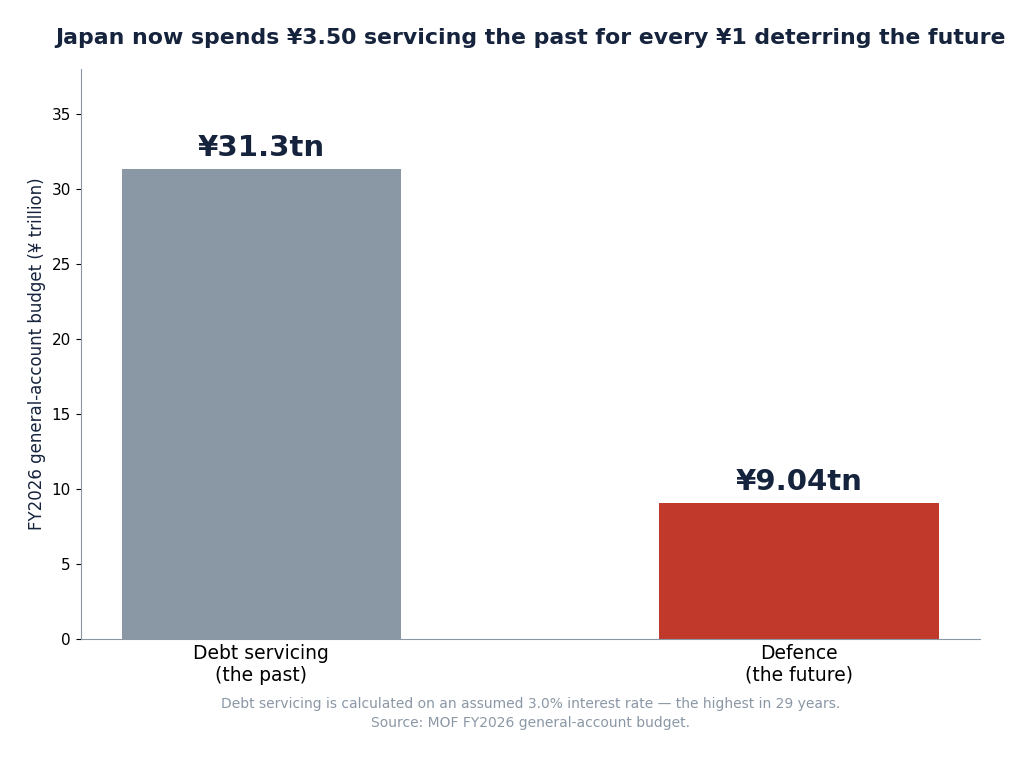
In the ¥122.3 trillion general-account budget for FY2026, debt servicing rose 10.8% to ¥31.3 trillion, calculated on an assumed interest rate of 3.0% — the highest assumption in 29 years. Set that beside ¥9.04 trillion of defense spending and the proportion is clear: Japan now spends roughly three and a half yen servicing the past for every yen spent deterring the future.
The curve is still moving. The 10-year JGB has reached 2.50%, its highest since 1997. The 40-year broke 4% for the first time in its history in January and has since passed 4.24%. Every hundred basis points across the curve eventually costs more than the entire annual increase in the defense budget.
Which is the real conclusion: the effective check on this government is the bond market, not the opposition. Japan has found its sword. Whether it can afford to keep swinging it will be answered in the December documents, not in the Diet.
What this means for the talent market
Everything above is usually filed under geopolitics. In practice it reaches an organisation as six line items — and five of them move faster than the fiscal constraint does.
The foreign-labour pipeline now has a number on it
This is the most consequential item for anyone staffing Japan, and the least covered. Plan against the 育成就労 first-cohort ceiling of roughly 426,000, not the 1.23 million aggregate target; the aggregate is not the instrument that will bind you. It is an Asia-wide issue, not a Japanese one — if you move workers into Japan from Vietnam, the Philippines, Indonesia, Myanmar or Nepal, your pipeline now has a queue. The domestic offset is the 年収の壁 reform, which releases hours from a workforce already in the country. Watch it if you staff shifts.
Yen-denominated compensation has stopped competing
At ¥163.99 to the dollar with core inflation above 2%, a Tokyo-based regional package that was competitive against Singapore or Hong Kong two years ago no longer is. No amount of 賃上げ inside a Japanese band closes a currency gap of that size. The exposure concentrates in the people hardest to replace: bilingual senior managers with regional mobility, who can price themselves in dollars while your band is set in yen. 定着 for that group has become a currency problem wearing an engagement survey.
A state-funded competitor has entered the engineering market
¥6.4 trillion of stimulus into semiconductors, AI and defense, SHIELD at ¥100.1 billion, and an explicit ministry intention to hire through technology companies and start-ups rather than only the primes. It does not need to beat you on cash — it competes on mission, stability and programmes measured in decades. The same applies outside Japan: eight of the eleven Australian frigates are slated for Western Australia, which means a shipbuilding workforce build-out with Japanese technology transfer attached, and a bilingual programme-management layer that does not exist there in the numbers required.
Export-control compliance has become a role, not a duty
Japan's April framework created an approval and end-use monitoring regime; China's 6 January measures point the other way. If your business touches machine tools, sensors, advanced materials, semiconductors, chemicals or freight forwarding, you need people who can classify dual-use items and answer to two opposed regimes. Three years ago that was a slice of a legal or trade-compliance job. Very few people in Asia have done it under Japanese and Chinese rules at once. Of everything here, it is the cheapest to fix and the least started.
The end of free money changes how you hold headcount
A policy rate at 1.0% and a 10-year at 2.50% follow a generation of near-zero funding. Carrying people through a soft quarter now has a cost, and thinly financed suppliers feel it first — Japan already has a term for the consequence, 人手不足倒産 (labour-shortage bankruptcies). My read is that this accelerates the drift toward 職務型 (job-based employment) and away from seniority pay, because rate pressure makes an unpriced pay curve expensive to defend.
Japan is no longer the low-volatility seat
Part of the case for a Japan regional headquarters used to be political predictability. That premium has narrowed: a supermajority pursuing constitutional revision, approval down twelve points in a month, and a channel to Beijing that both capitals describe differently. You do not need a view on any of it. You need a scenario plan that does not assume quiet, and one named person who owns it.
What to do this quarter
- Re-run your 2027–2029 Japan headcount plan against a capped intake, and ask your immigration counsel about the first-cohort allocation mechanism rather than the aggregate target.
- Re-benchmark every Japan-based regional role in dollars. Where the gap to Singapore exceeds one band, you are holding a resignation you have not yet received.
- Name your top twenty bilingual retention risks and price them individually. A band-wide 賃上げ will not hold them; it will only cost more.
- Map your engineering requisitions against the defense and semiconductor programmes now hiring in your cities. Where you cannot win on mission, win on scope and programme length.
- Decide who owns dual-use classification. If the answer is legal, partly, you do not have the function — you have an exposure.
- Stress-test your Japan people cost at a 1.5% policy rate before the September BOJ meeting, not after it.
The fiscal wall is real, but it bites in years. Visa ceilings, currency, engineer supply and compliance capability bite in quarters. That is the difference between reading this as a defense story and reading it as a talent market.
Sources
Japan Ministry of Defense, Defense of Japan 2026 white paper, adopted 4 August 2026; Ministry of Foreign Affairs; MOF FY2026 general-account budget; Bank of Japan Outlook Report and policy statement, 31 July 2026; Cabinet Office Q2 2026 GDP release; IMF Article IV Consultation with Japan, April 2026; Mitsubishi Heavy Industries and Australian Department of Defence, 18 April 2026; Yomiuri Shimbun, Jiji Press and Mainichi Shimbun polling, July 2026. Foreign-worker figures are planned ceilings reported from government plans (Nikkei Asia, The Japan Times) and remain subject to final approval. Currency, rate and yield levels as at late July 2026; debt-to-GDP varies materially by methodology.