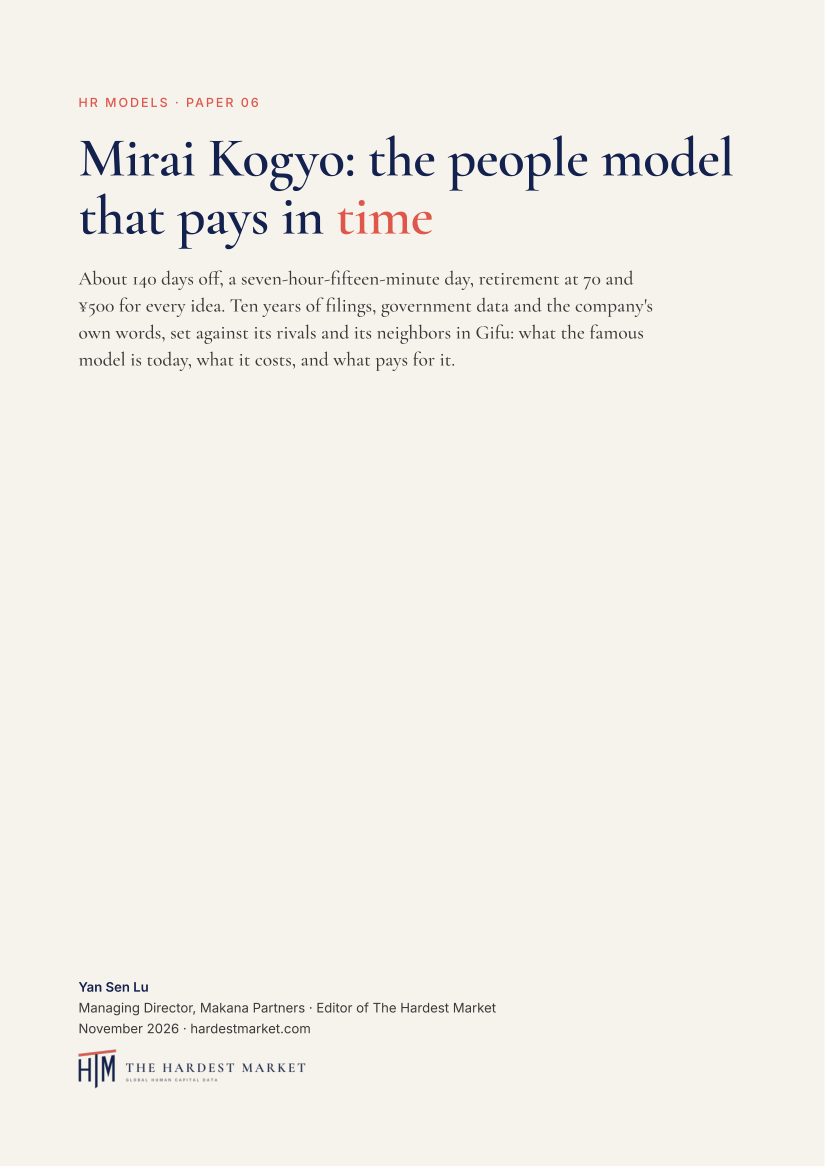
Mirai Kogyo, a maker of electrical boxes and conduit in Gifu Prefecture, is Japan's best-known example of a company that treats its people unusually well. This paper, published in November 2026, tests the story against its annual securities reports from FY2016 to FY2025, its earlier IR documents, its entries in the labor ministry's databases, its own management-policy text and its rivals Nitto Kogyo and Inaba Denki Sangyo.
Instant download. Polar handles payment, tax and the receipt. Paid newsletter subscribers get 30% off. Buying for a team? Ask for a quote.
Verdict
Mirai Kogyo pays its people in time: about 140 days off, almost no overtime, retirement at 70 and a job for life, in exchange for pay that has barely moved in a decade and sits below its national rivals'. The model is real, it has survived its founder, and it is narrower than its legend. Its margin is 1.6 to 2.4 times its peers', and the record says that comes from what it sells and how it prices.
What the evidence says
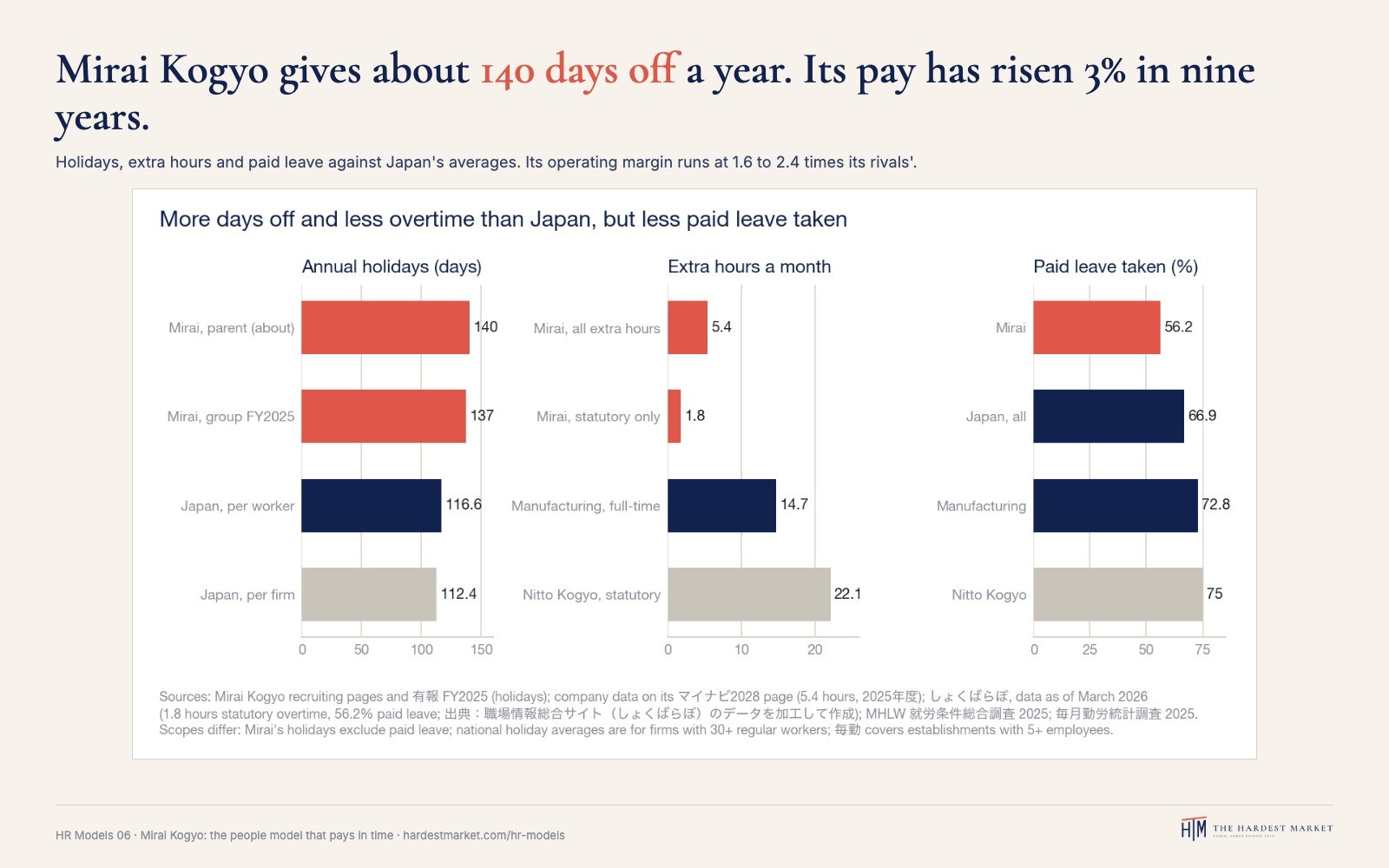
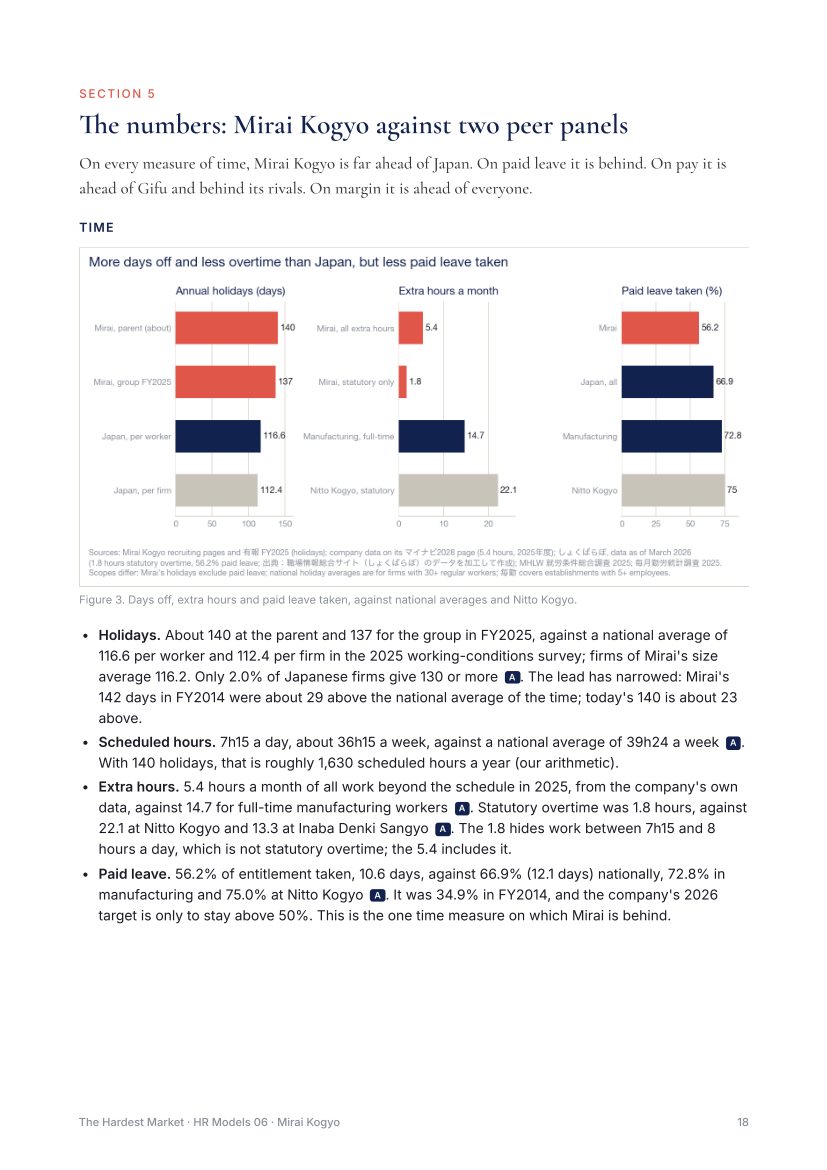
- Time instead of money. About 140 holidays a year against a national average of 116.6, and 5.4 hours of extra work a month against 14.7 in manufacturing. Average pay rose 3.1% in nine years, to ¥6.58 million; its rivals pay ¥7.21 million and ¥9.89 million.
- More than similar-sized Gifu firms pay. Mirai pays about ¥1.1 million more than the median of the three other listed Gifu manufacturers of its size (Ibiden, the prefecture's largest, pays more), so the trade is a regional premium in cash and a national premium in days.
- The margin comes from the products. Operating margin of 10.2% to 16.6% against a peer median of 5.3% to 7.5%. The company explains its results by sales, prices and products; the jump to 16.6% in FY2023 came in a year when nothing about people changed.
- The practices came in stages, for recruiting. Suggestions in 1977, the short day after 1985, holidays raised in the late-1980s hiring boom, the overtime ban enforced around 2005, retirement at 70 in 2006. The founder's son: the 140 days "were for recruiting".
- Narrower than the legend. The overtime "ban" became a goal, horenso "banned" became "not forced", the parent uses a few agency workers, suggestions halved, and paid-leave uptake is 56%, below the national average.
What's inside
- The model piece by piece: holidays, the short day and the overtime ban, all-regular employment, retirement at 70, suggestions, no quotas and no orders, with an evidence grade on every claim
- Time against money: holidays, extra hours and paid leave against Japan's averages, and pay against rivals and Gifu neighbors
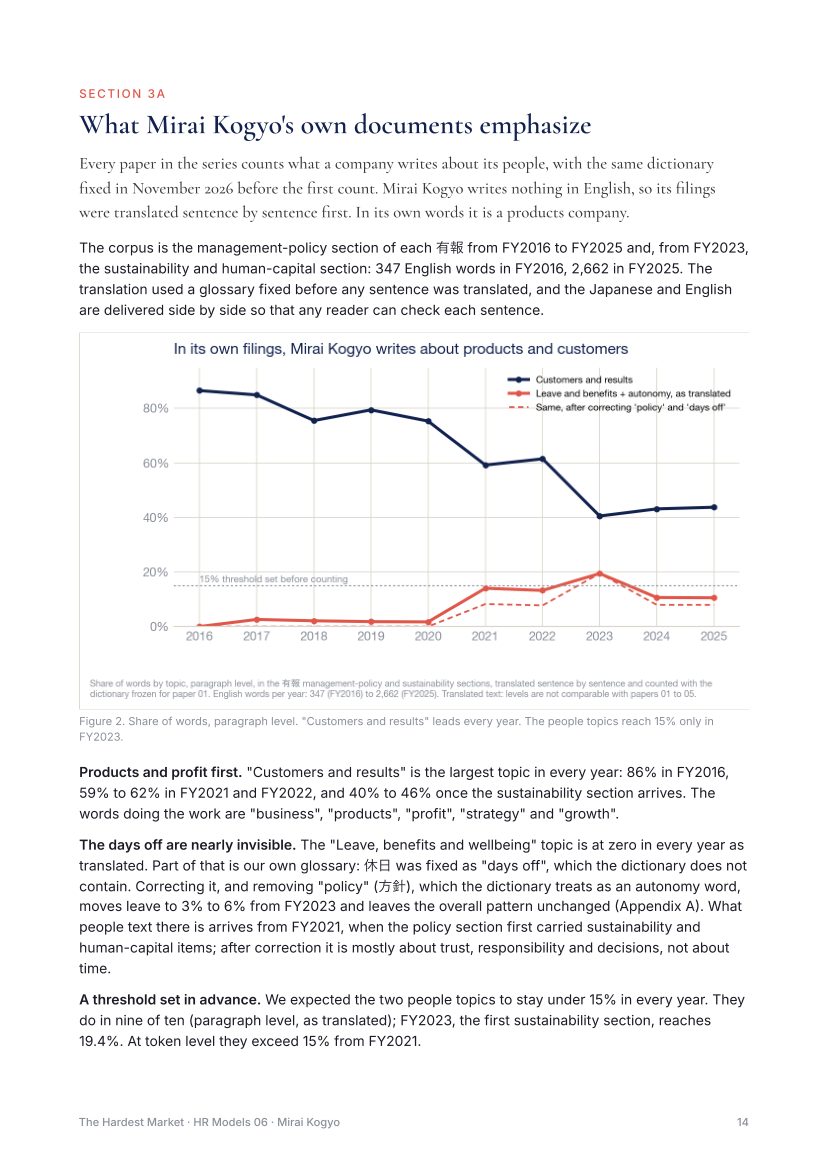
- What Mirai Kogyo's own filings emphasize, translated sentence by sentence and counted with the same dictionary as papers 01 to 05
- Did the people model drive the results, or did the products? Margins since FY1999 and what the company says drives them
- What softened, what held, and what it cost
- The copycats: heavily visited, rarely copied
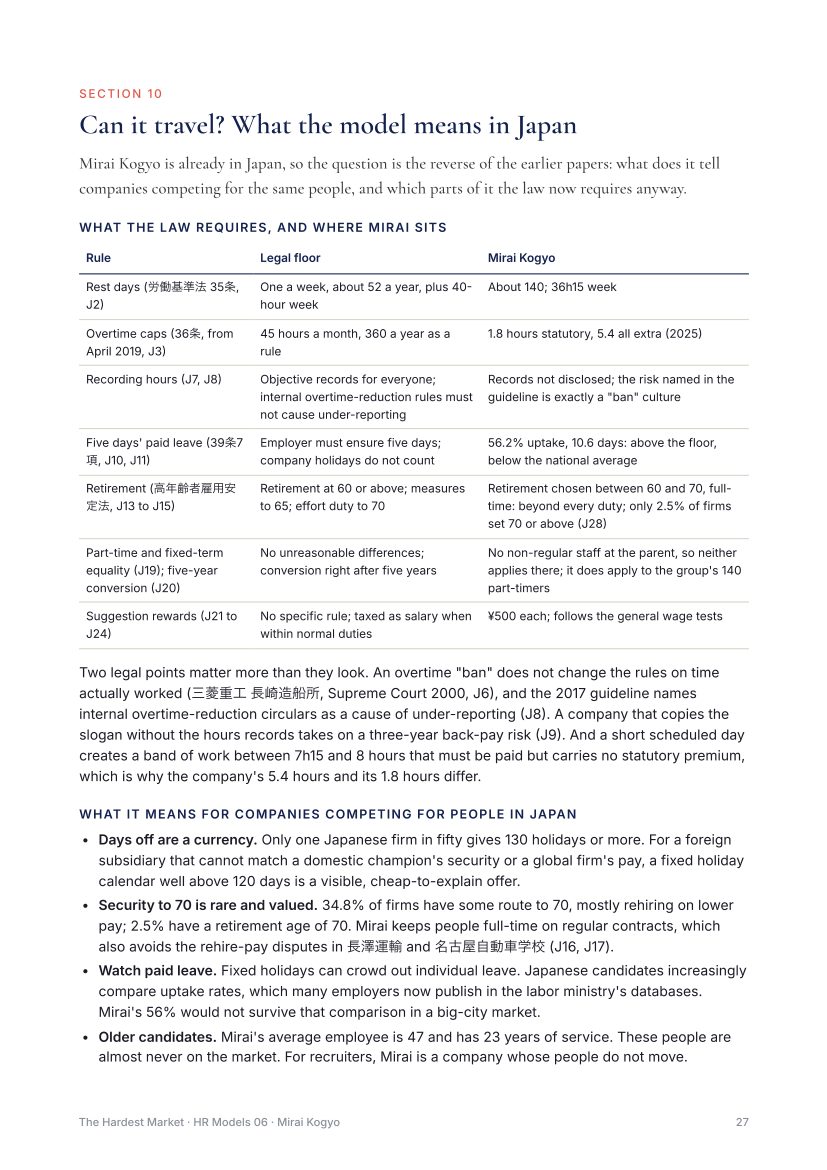
- Can it travel? The model under Japanese labor law, and what it means for employers competing for the same people
- A rollout playbook with gates and kill criteria, a scorecard, and the full text-analysis counts
Look inside
Who it is for
- Employers outside Tokyo competing for people with bigger namesHow a regional company recruits with days off and security instead of pay, and what that costs.
- HR leaders asked to cut overtime or add holidaysWhich rules held at Mirai and which softened, and the record-keeping risk in an overtime "ban".
- Foreign companies in Japan designing an employer brandWhy a fixed holiday calendar is a visible offer, and why paid-leave uptake now gets compared.
How we did it
We wrote down what we expected to find before reading a single document, and kept the predictions we got wrong in the paper: two of six survived intact. Mirai Kogyo publishes nothing in English, so its filings were translated sentence by sentence with a glossary fixed in advance, and the Japanese and English are delivered side by side. Every claim carries an evidence grade, and each section ends with what it does not prove.
By Yan Sen Lu, Managing Director of Makana Partners and Editor of The Hardest Market.
Instant download. Polar handles payment, tax and the receipt. Paid newsletter subscribers get 30% off. Buying for a team? Ask for a quote.
Questions
What format is the paper, and what language?
A 41-page PDF in English, published November 2026. Japanese statutes and government data are cited by name.
Do I need to read the earlier papers first?
No. Each paper stands alone. All six use the same text-analysis dictionary, so they can be read side by side.
How do I receive it?
Polar, our payment provider, emails a download link straight after payment. You can download it again at any time from the Polar customer portal.
Who handles tax and receipts?
Polar is the merchant of record, so it charges any sales tax due and issues the receipt.
Can my team or company share one copy?
One purchase is for one reader. For a team or company-wide license, a purchase order or an invoice, write to editor@hardestmarket.com for a quote.
Do newsletter subscribers get a discount?
Yes. Paid subscribers to The Hardest Market newsletter get 30% off. The code is in the paid-subscriber emails.
Is this affiliated with Mirai Kogyo?
No. It is an independent analysis of public sources: Mirai Kogyo's filings and web pages, government databases, statistics and press reports. Mirai Kogyo did not review it.