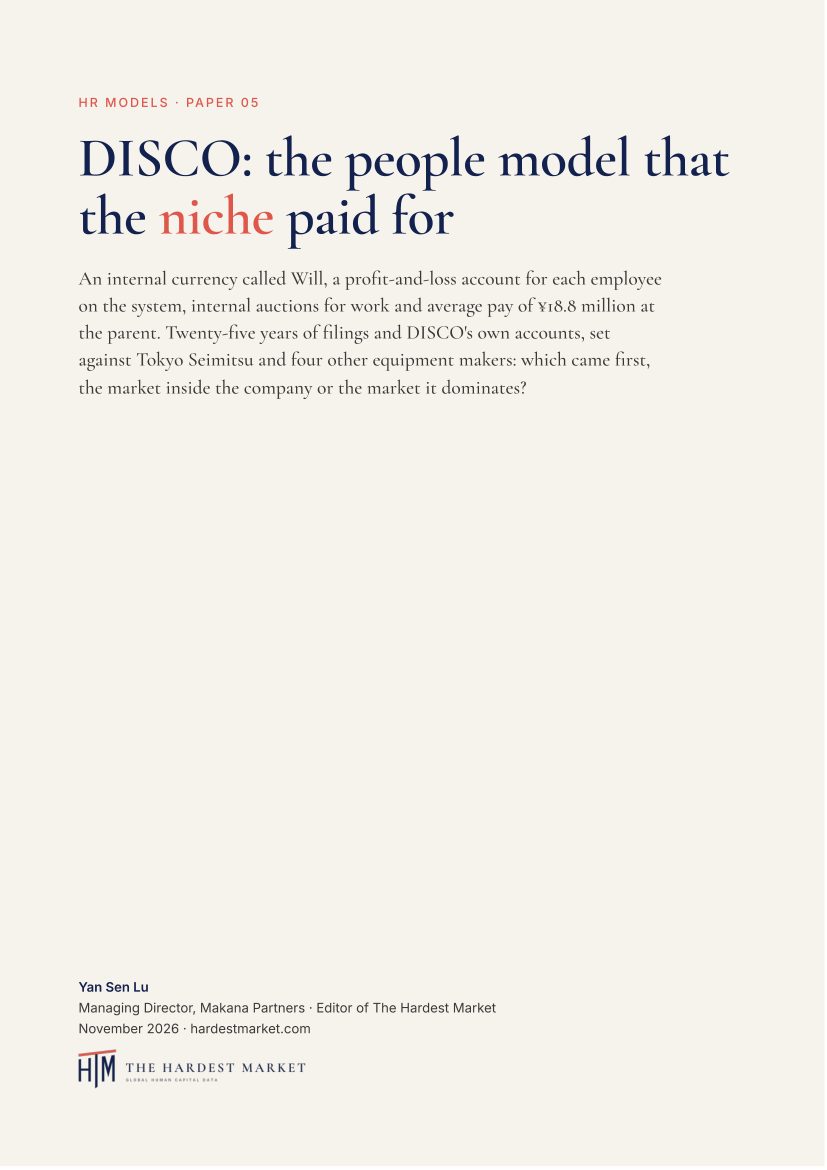
At DISCO, the semiconductor-equipment maker, employees buy colleagues' time in an internal currency, bid for work, book their mistakes as personal losses and are paid partly by what colleagues paid them. Average pay at the parent reached ¥18.8 million in FY2025. This paper, published in November 2026, tests the story against DISCO's filings from FY2000 to FY2025, its own descriptions of Will and its market share, and Tokyo Seimitsu, Tokyo Electron, Advantest, Lasertec, SCREEN and Keyence.
Instant download. Polar handles payment, tax and the receipt. Paid newsletter subscribers get 30% off. Buying for a team? Ask for a quote.
Verdict
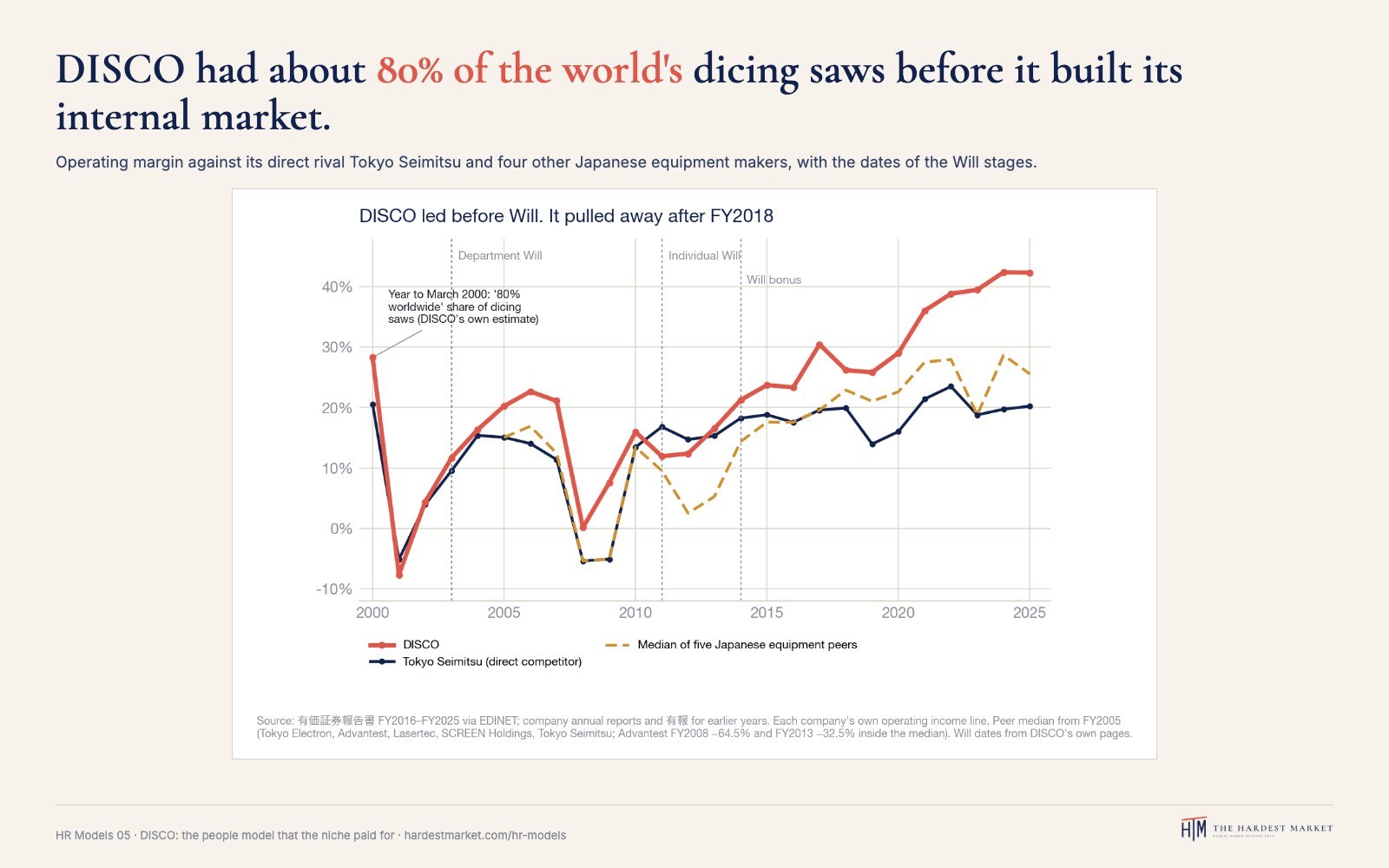
DISCO runs the most radical people model in Japan, and it came after the business, not before. DISCO claimed about 80% of the world market for dicing saws in the year to March 2000, three years before Will existed at department level and eleven before it reached individuals. Will does not set pay: the profit margin sets the bonus pool, and Will divides it.
What the evidence says
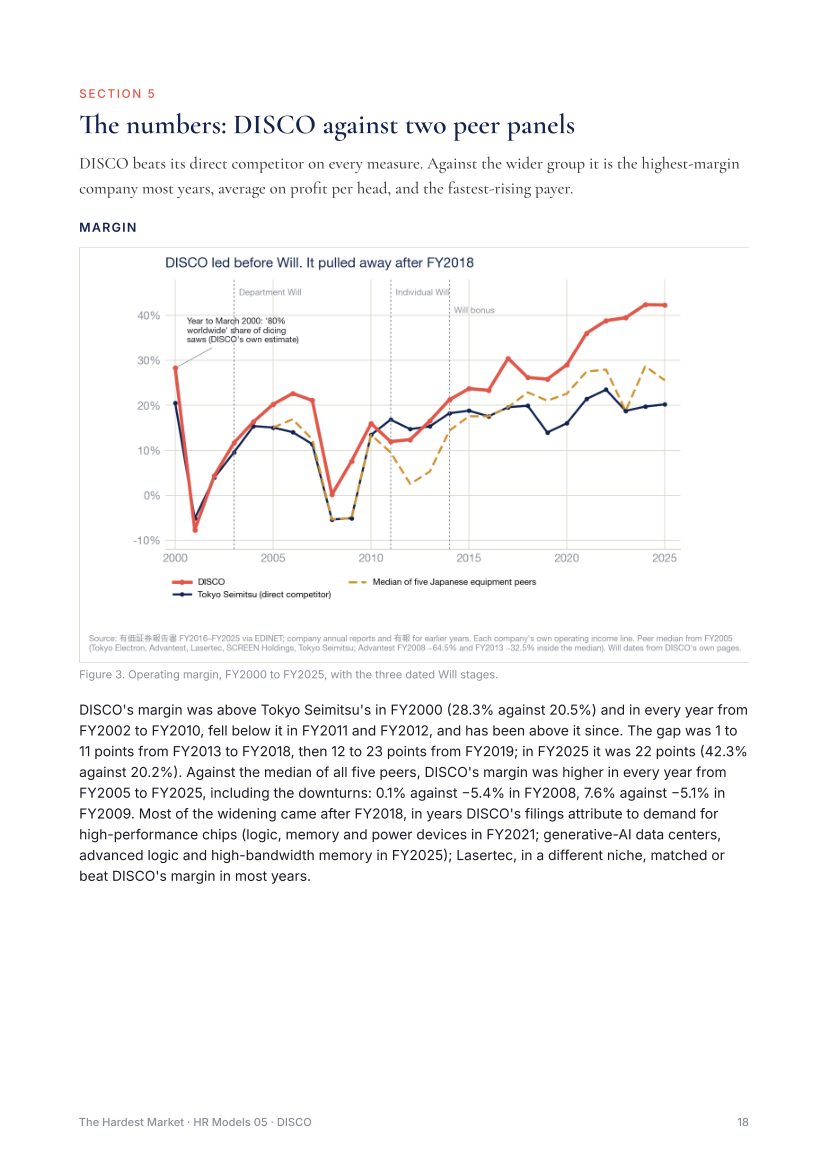
- The niche came first. DISCO's own Annual Report 2000 put its dicing-saw share at about 80% worldwide and 90% in Japan, a company estimate. Its margin was above its direct rival's in FY2000 and every year from FY2002 to FY2010, before individual Will began in 2011.
- Will divides the bonus; the margin sets it. The bonus pool follows the consolidated ordinary-profit margin, with a floor of four months a year; Will allocates it to departments and people. Bonuses averaged 20.9 months in FY2022. Press reports put the Will-linked share at 37% to 40%.
- Pay more than doubled. Average pay at the parent rose from ¥8.91 million in FY2016 to ¥18.80 million in FY2025, against a peer median of +22%, as operating income rose almost sixfold.
- Ahead of its rival, average against the rest. Operating income per employee beat Tokyo Seimitsu every year from FY2016, but beat the median of five equipment makers in only five of ten years.
- The costs are on the record. 50.6 hours of overtime in FY2024 against a 14.5-hour manufacturing average, a commit allowance that three in four regular staff took on condition they resign if judged to fail, and DISCO's own published accounts of people who left.
What's inside
- The model piece by piece: the Will currency and accounts, auctions, losses instead of reprimands, free transfer, spending authority and the commit allowance, with an evidence grade on every claim
- How pay works: a bonus pool set by the profit margin, divided by Will
- DISCO against Tokyo Seimitsu, Tokyo Electron, Advantest, Lasertec, SCREEN and Keyence on margin, profit per employee and pay, FY2000 to FY2025
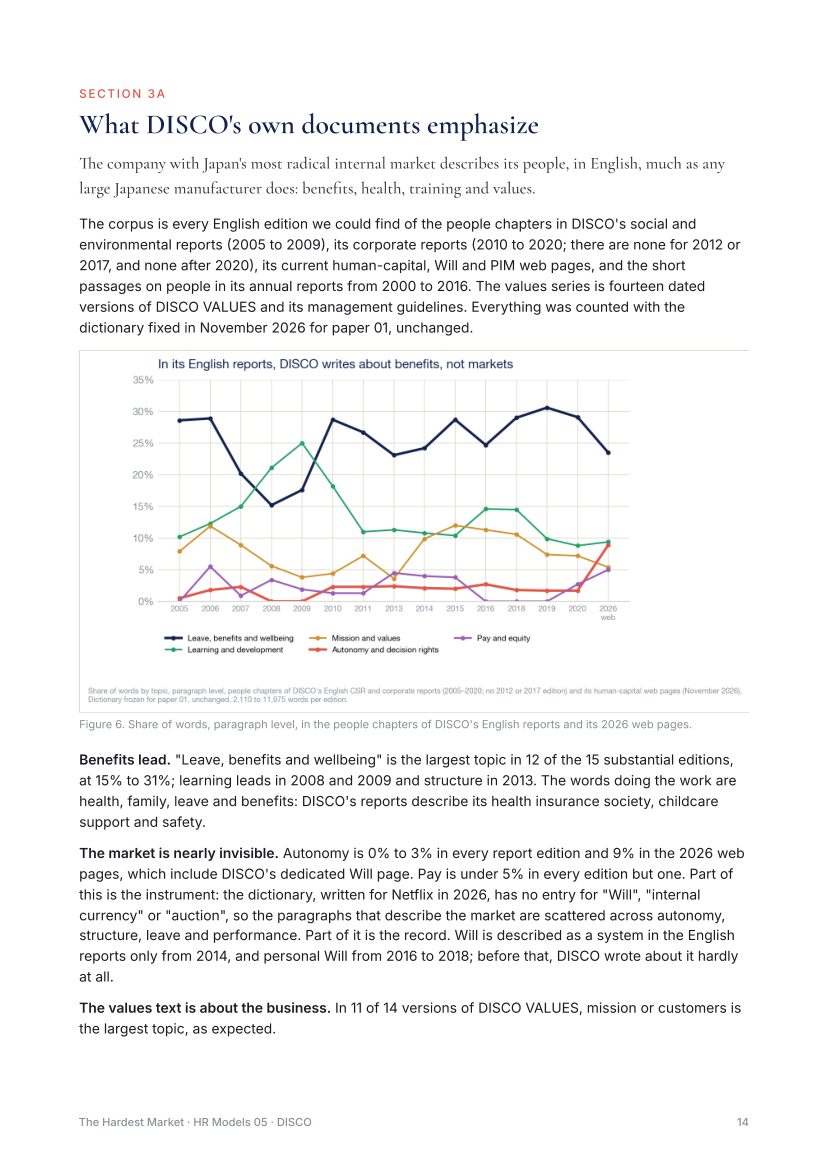
- What DISCO's own English reports emphasize, counted with the same dictionary as papers 01 to 04
- Did the internal market drive the results, or did the niche? The dates, the share claims and the one documented mechanism
- What it costs: overtime, exposure to colleagues' judgment, and the people who leave
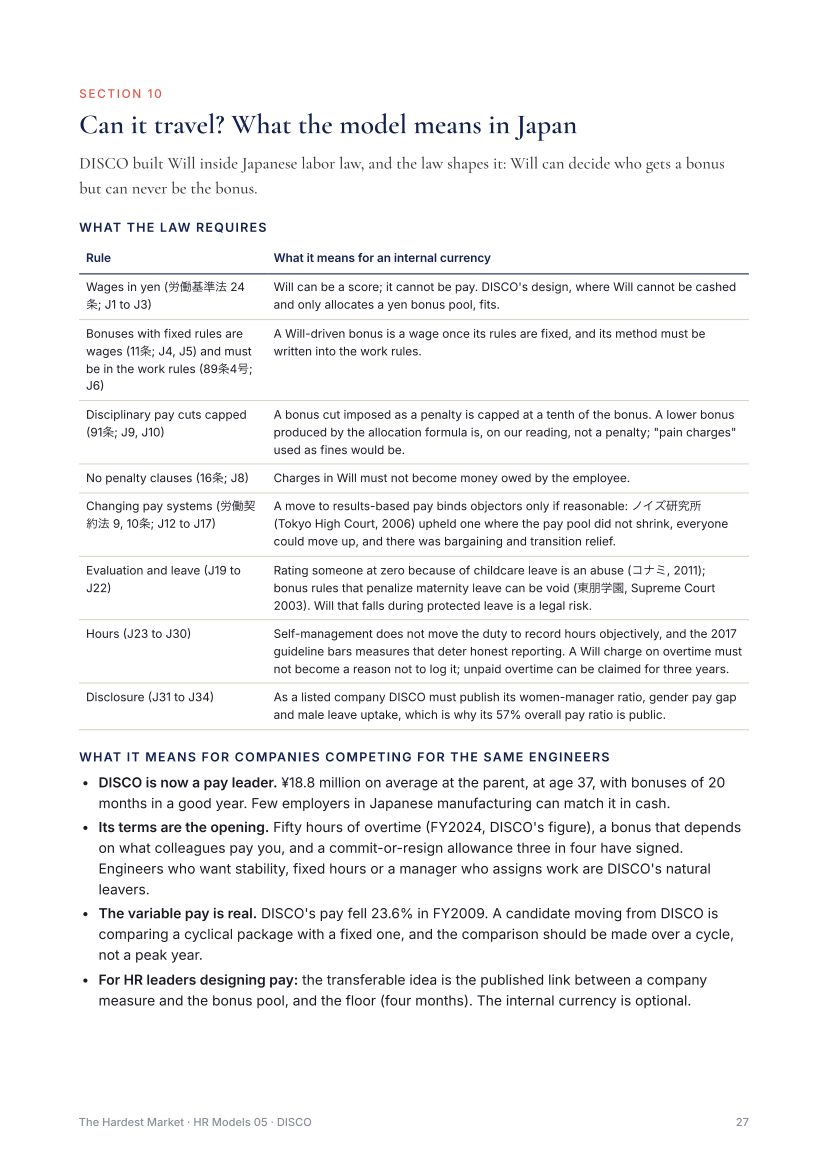
- Can it travel? Japanese wage law, and what DISCO means for companies hiring the same engineers
- A rollout playbook with gates and kill criteria, a scorecard, and the full text-analysis counts
Look inside
Who it is for
- HR leaders asked about "internal markets" or self-managing organizationsWhat DISCO actually built, in what order, and which parts work without a dominant product.
- Companies competing with DISCO for engineers in JapanWhat DISCO now pays, how its pay moves in a downturn, and where its terms leave room for a different offer.
- Pay and reward specialistsHow a profit-linked bonus pool with a floor keeps labor cost variable, and how an internal currency divides it.
How we did it
We wrote down what we expected to find before reading a single document, and kept the predictions we got wrong in the paper: two of six survived intact. The text analysis uses the same dictionary as papers 01 to 04. Every claim carries an evidence grade, company share claims are treated as claims, and each section ends with what it does not prove.
By Yan Sen Lu, Managing Director of Makana Partners and Editor of The Hardest Market.
Instant download. Polar handles payment, tax and the receipt. Paid newsletter subscribers get 30% off. Buying for a team? Ask for a quote.
Questions
What format is the paper, and what language?
A 40-page PDF in English, published November 2026. Japanese statutes and government data are cited by name.
Do I need to read the earlier papers first?
No. Each paper stands alone. All five use the same text-analysis dictionary, so they can be read side by side.
How do I receive it?
Polar, our payment provider, emails a download link straight after payment. You can download it again at any time from the Polar customer portal.
Who handles tax and receipts?
Polar is the merchant of record, so it charges any sales tax due and issues the receipt.
Can my team or company share one copy?
One purchase is for one reader. For a team or company-wide license, a purchase order or an invoice, write to editor@hardestmarket.com for a quote.
Do newsletter subscribers get a discount?
Yes. Paid subscribers to The Hardest Market newsletter get 30% off. The code is in the paid-subscriber emails.
Is this affiliated with DISCO?
No. It is an independent analysis of public sources: DISCO's filings, reports and web pages, government data and press reports. DISCO did not review it.