The average misleads
The national job-to-applicant ratio — 1.18 openings for every seeker — is a blended figure. Blended figures comfort executives and mislead them to think it's bad, but not that bad. Look underneath it and the market splits into two economies that barely touch each other.
Construction runs at roughly 6.7 openings per applicant. Clerical and administrative roles run at about 0.45 — fewer than one opening for every two people looking. Same country. Same month. One field is starving; the other has a glut.
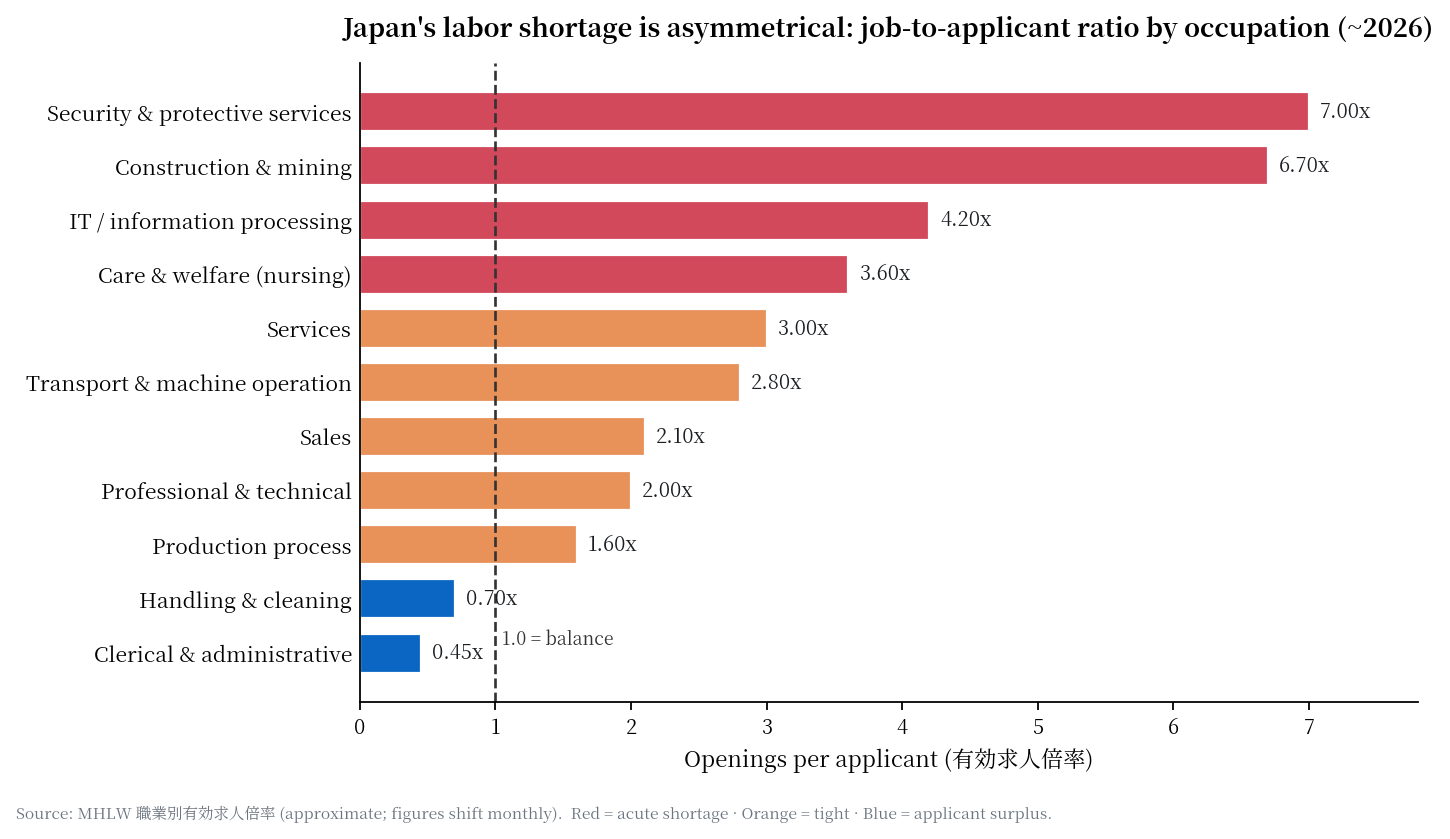
So when a board hears "labor shortage" and pictures a uniform scramble for bodies, they misread their own problem. There is no shortage of people who want administrative jobs. There is a savage shortage of the specific, scarce profiles that actually move a business forward: IT (reportedly ~220,000 professionals short), nursing and care, cybersecurity, AI specialists, skilled trades — and, the one I live in every day, bilingual senior leaders who can operate between a global HQ and a Japanese organization.
That last group isn't in any headline ratio at all. It's a rounding error in the national data and the single hardest hire most of my clients will make this year.
Why this is structural, not a rough patch
Here's the part that should change how you plan. This isn't a hot economy temporarily outrunning its labor supply — the kind of crunch that eases when growth cools. It's demographics. Japan's working-age population is shrinking as the country ages. The OECD — the Paris-based group of advanced economies whose Employment Outlook tracks this — frames it as a multi-year problem that gets worse, not one that reverts to the mean.
Translation for hiring leaders: the talent you can't find today does not become easier to find next quarter by waiting. Scarcity is the baseline now, not the exception.
What the mismatch actually costs you
Wages are moving where it's tight, not everywhere. Starting salaries in shortage fields are climbing to lock talent in early. If your comp bands were set for the "blended" market, you're already underbidding in the roles you most need to win.
Smaller competitors are failing — and their people are in motion. "Labor-shortage bankruptcies" (人手不足倒産) are real: firms that simply can't staff. That reshuffles good people into the market for those quick enough to catch them.
Retention beat recruiting on cost. When a replacement takes this long and pays this much, keeping your bilingual bench (定着) is no longer an HR nicety. It's a P&L decision.
What to do about it
Segment your roles by their real ratio, not the national one. Know which of your open seats sit in the 6x world and which sit in the 0.4x world. Resource them completely differently. Volume tactics for surplus roles are wasted — sometimes counterproductive — on scarcity roles.
For the scarce, bilingual, senior seats, assume they will not apply. These people are employed, not looking, and invisible to job boards. They are reached, not attracted. If your strategy for a critical leadership hire is a posting and a prayer, you don't have a strategy.
Decide faster than the market. In a 6x segment, your process length is your biggest source of loss. The best candidate you interview this month is interviewing elsewhere this month too.
Japan's headline shortage will be quoted in every board deck this year. The firms that win won't be the ones who quote it best. They'll be the ones who stopped reading the average and started hiring against the number that's actually true for their roles.
That's the whole game and it's only gonna get more difficult.