Patagonia opened on-site child care in 1983, paid its staff to protest, closed on Election Day and never gave anyone a share. In September 2022 the founding family gave the whole company to a trust and a group of non-profits. Patagonia publishes no profit figures, so this paper, published in November 2026, tests the model against what is public: B Lab's scores, the non-profit owners' US tax returns, posted pay against VF and Columbia, and layoffs against four rivals.
Instant download. Polar handles payment, tax and the receipt. Paid newsletter subscribers get 30% off. Buying for a team? Ask for a quote.
Verdict
Patagonia's people model was built by its ownership. One family, with no investors to answer to, spent forty years adding benefits and never taking them away, and it pays store staff more cash than its rivals, with no shares. Within four years of the family handing the company over, and in its first sales decline, the model began to bend.
What the evidence says
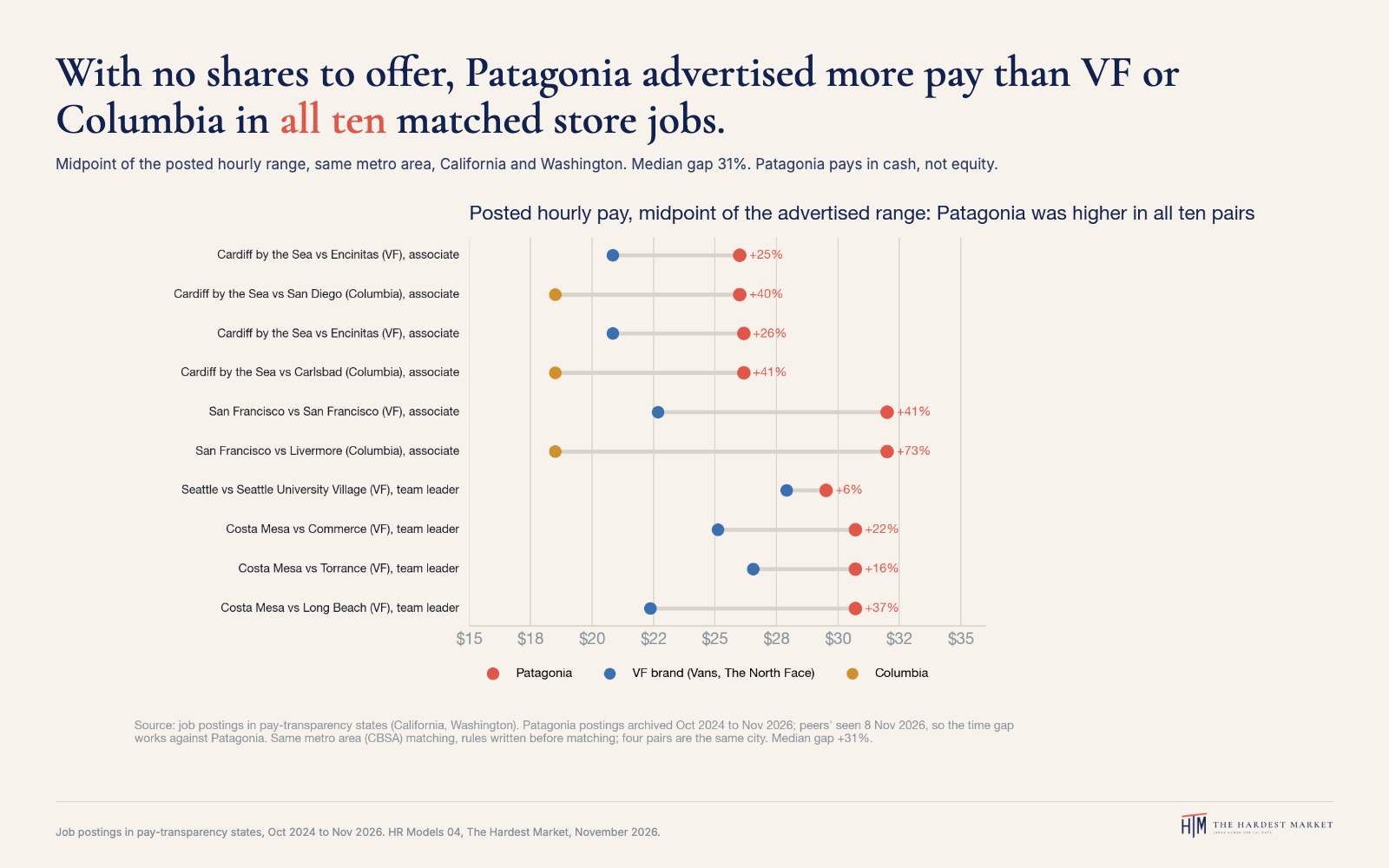
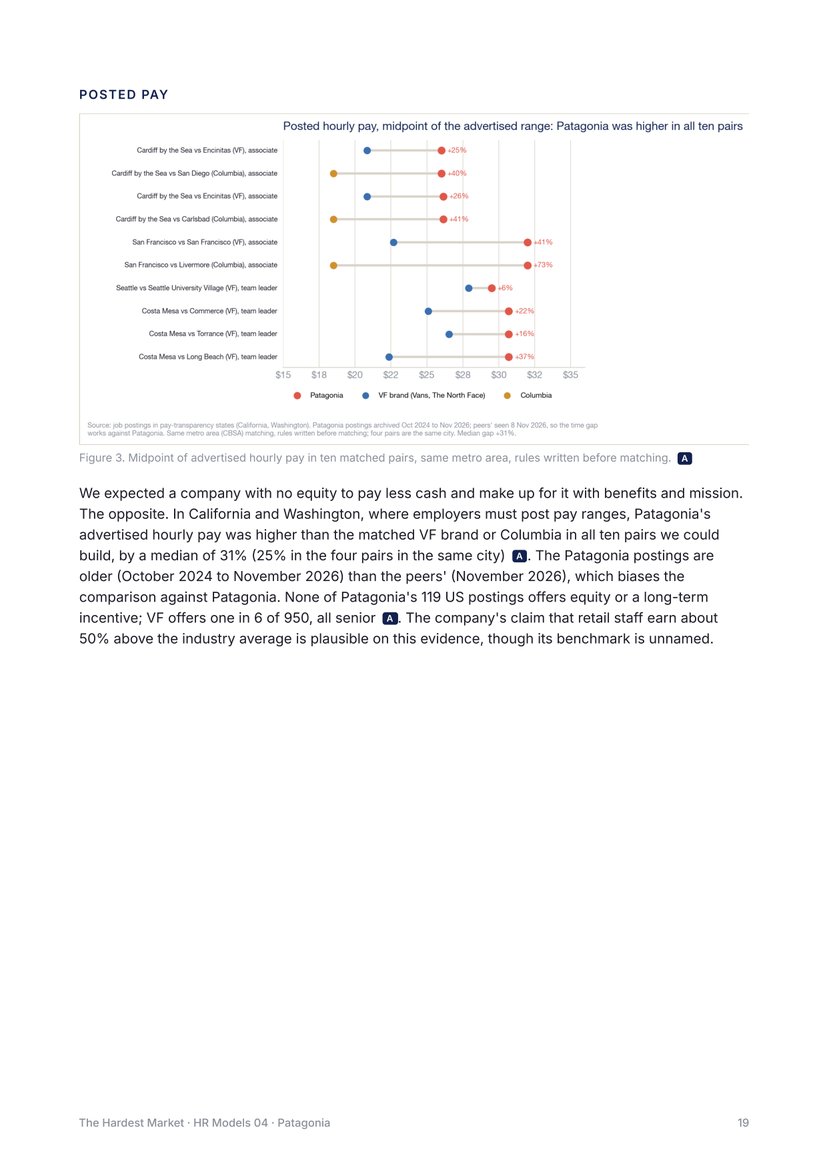
- It pays more cash, not less. In ten matched job advertisements in California and Washington, Patagonia advertised more than VF’s brands or Columbia every time, by a median of 31%. None of its US postings offers equity.
- The model was built under one owner. On-site child care (1983), giving 1% of sales (1985), benefit-corporation status (2012), bail and protest training, Election Day closures: every signature practice dates from the years the Chouinard family owned the company outright.
- Then it began to bend. After the 2022 transfer and in its first sales decline: after-school care and summer camp ending by June 2026, two-month activism internships replaced by up to 18 paid hours a year, 41 head-office roles cut, and two US stores unionised.
- The outside score rose. The score for workers did not. Patagonia’s B Corp score rose from 107 to 166 between 2011 and 2024, almost all of it in giving and suppliers. Its score for workers fell from 25 to 23.7.
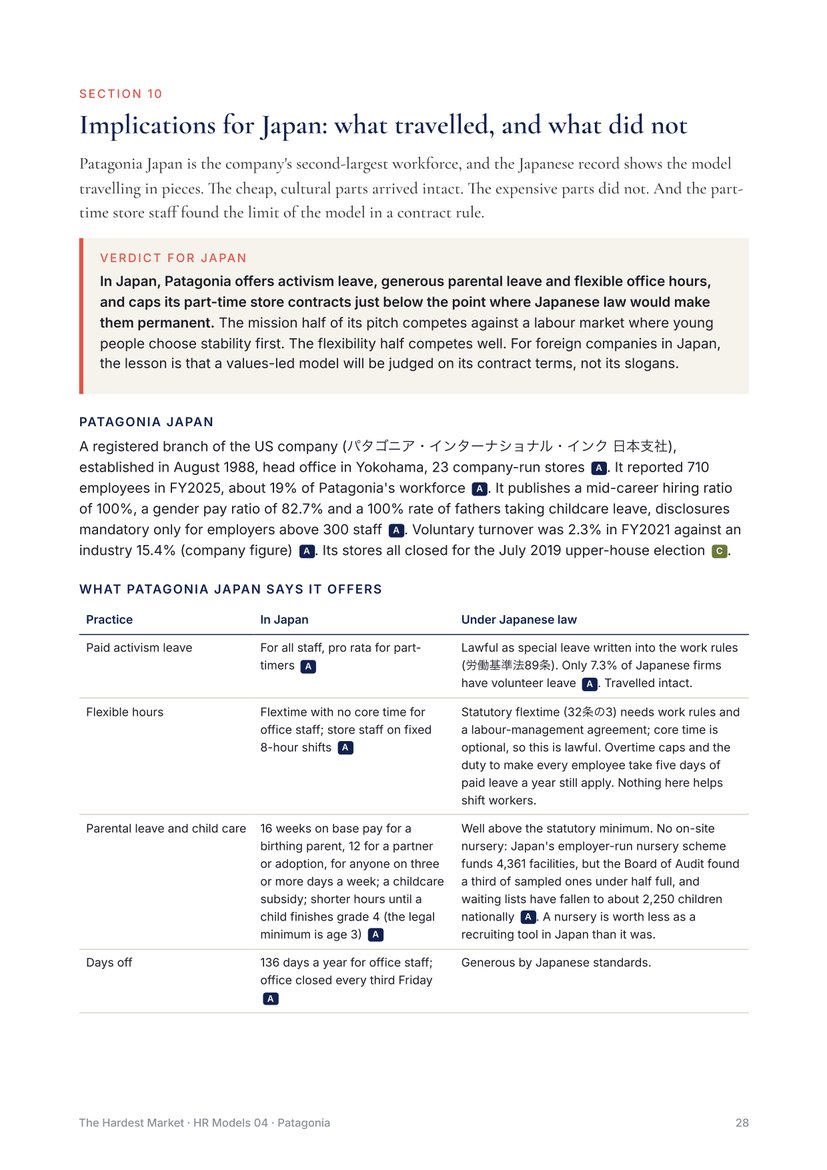
- In Japan, the cheap parts travelled. Patagonia Japan, with 710 staff, offers activism leave, office flextime and 16 weeks’ paid parental leave. It has no nursery, no bail support, and caps part-time store contracts just below the five-year point at which Japanese law allows a permanent contract.
What's inside
- The model piece by piece: child care, flexible hours, activism and bail support, Election Day closures, pay and benefits, exits and unions, with an evidence grade on every claim
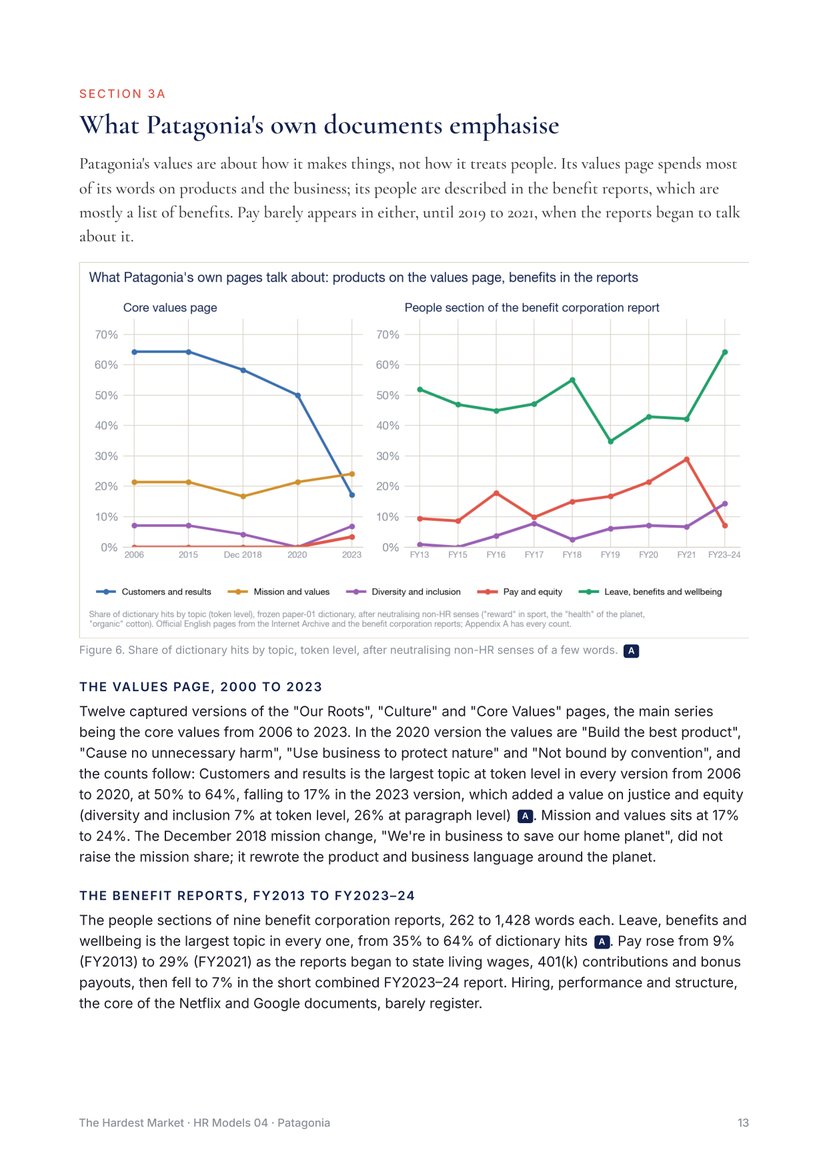
- What Patagonia's own documents emphasise, across its values pages and benefit reports, counted with the same dictionary as papers 01 to 03
- Posted pay against VF and Columbia, B Corp scores from 2011 to 2024, and the dividends its non-profit owners report
- Did the model last, and what held it up? Built over forty years under family ownership, bent within four after the transfer
- Reversals and costs: child care narrowed, internships replaced, head-office cuts, two US unions
- The copycats, and what happened to them
- Implications for Japan: what Patagonia Japan offers, what Japanese law allows, and the part-time contract cap
- A rollout playbook with gates and kill criteria, a scorecard, and the full text-analysis counts
Look inside
Who it is for
- Foreign companies in Japan selling a values-led employer brandWhat travels to Japanese job-seekers, who rank stability far above purpose, and why contract terms for part-time staff decide how the brand is read.
- HR leaders asked to "be more like Patagonia"Which benefits are cheap and portable, which need an owner willing to pay, and what to decide in advance about cutting them.
- Founders thinking about ownership and successionWhat happened to a famous people model when the family handed the company to a trust, and what the record can and cannot say about why.
How we did it
We wrote down what we expected to find before reading a single document, and kept the predictions we got wrong in the paper: none of the six survived intact. Because Patagonia publishes no accounts, we fixed in advance tests the public record can support, and capped the financial-linkage score. The text analysis uses the same dictionary as papers 01 to 03. Every claim carries an evidence grade, and each section ends with what it does not prove.
By Yan Sen Lu, Managing Director of Makana Partners and Editor of The Hardest Market.
Instant download. Polar handles payment, tax and the receipt. Paid newsletter subscribers get 30% off. Buying for a team? Ask for a quote.
Questions
What format is the paper, and what language?
A 43-page PDF in English, published November 2026. Japanese statutes and government data are cited by name.
Do I need to read the earlier papers first?
No. Each paper stands alone. All four use the same text-analysis dictionary, so they can be read side by side.
How do I receive it?
Polar, our payment provider, emails a download link straight after payment. You can download it again at any time from the Polar customer portal.
Who handles tax and receipts?
Polar is the merchant of record, so it charges any sales tax due and issues the receipt.
Can my team or company share one copy?
One purchase is for one reader. For a team or company-wide licence, a purchase order or an invoice, write to editor@hardestmarket.com for a quote.
Do newsletter subscribers get a discount?
Yes. Paid subscribers to The Hardest Market newsletter get 30% off. The code is in the paid-subscriber emails.
Is this affiliated with Patagonia?
No. It is an independent analysis of public sources: Patagonia's own reports and pages, B Lab's records, public tax returns, job postings, government data and press reports. Patagonia did not review it.