Hitachi lost ¥787 billion in the year to March 2009 and reported a record 11.3% margin in the year to March 2026. In between it built one global system for grading, paying and moving people, and spent seven years negotiating it with its union in Japan. This paper, published in November 2026, tests what that people model actually did, using Hitachi's annual securities reports, spring wage settlements and hiring plans, and sets the results against Siemens and four Japanese rivals: Fujitsu, NEC, Mitsubishi Electric and Panasonic.
Instant download. Polar handles payment, tax and the receipt. Paid newsletter subscribers get 30% off. Buying for a team? Ask for a quote.
Verdict
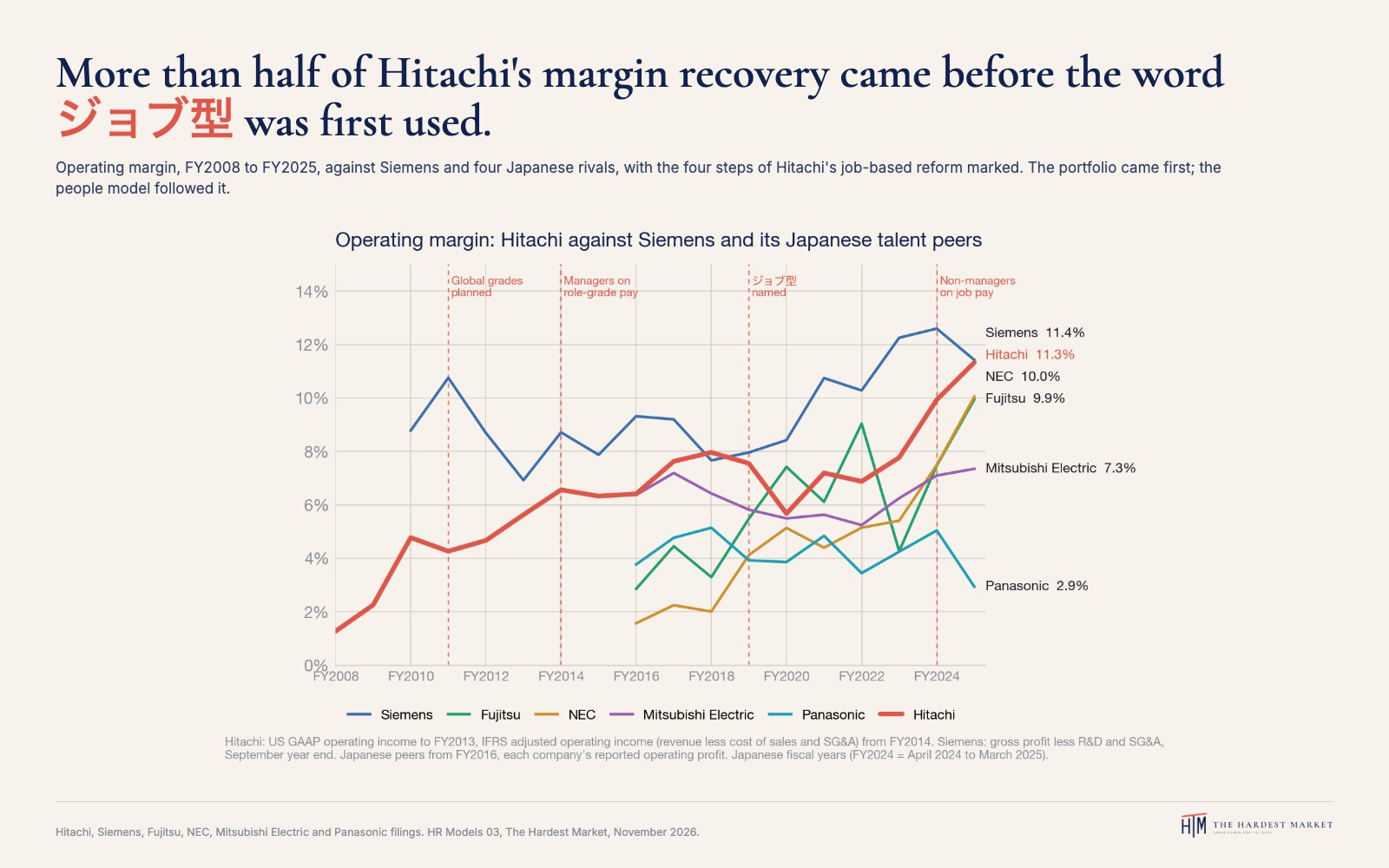
Hitachi's people model did not save Hitachi. The portfolio did, and the people model followed it. More than half of the margin recovery came before Hitachi first used the term job-based, and almost all the profit growth since 2019 came from the power-grid business it bought from ABB and from IT. In Japan, the reform changed pay and hiring, not employment security.
What the evidence says
- The portfolio came first. Hitachi's margin rose from 2.3% (FY2009) to 7.6% (FY2019) to 11.3% (FY2025). 58% of the rise came before March 2019, when Hitachi first used the term job-based. From FY2019 to FY2025 the power-grid business bought from ABB and the IT segment added ¥519 billion of the ¥537 billion increase in profit.
- The reform took thirteen years, by agreement. A global grade for 50,000 manager positions (FY2013), 11,000 Japanese managers on role-grade pay (2014), union talks from 2017, and 20,000 non-managers moved from ability pay to job pay only in June 2024, with a tapering top-up for anyone whose pay fell.
- Pay at the parent grew more slowly than at every rival. Average pay at Hitachi, Ltd. rose 10% from FY2019 to FY2025, against 13% to 31% at Fujitsu, NEC, Mitsubishi Electric and Panasonic, and its ¥1 million lead disappeared. At the top, four non-Japanese executives were paid more than the CEO in FY2025.
- Hiring is where it changed most. Mid-career hires at Hitachi, Ltd. rose from about 150 a year to 850 in FY2025, more than the 770 new graduates for the first time. 1,100 are planned for FY2026, about 100 of them at section-head level and above.
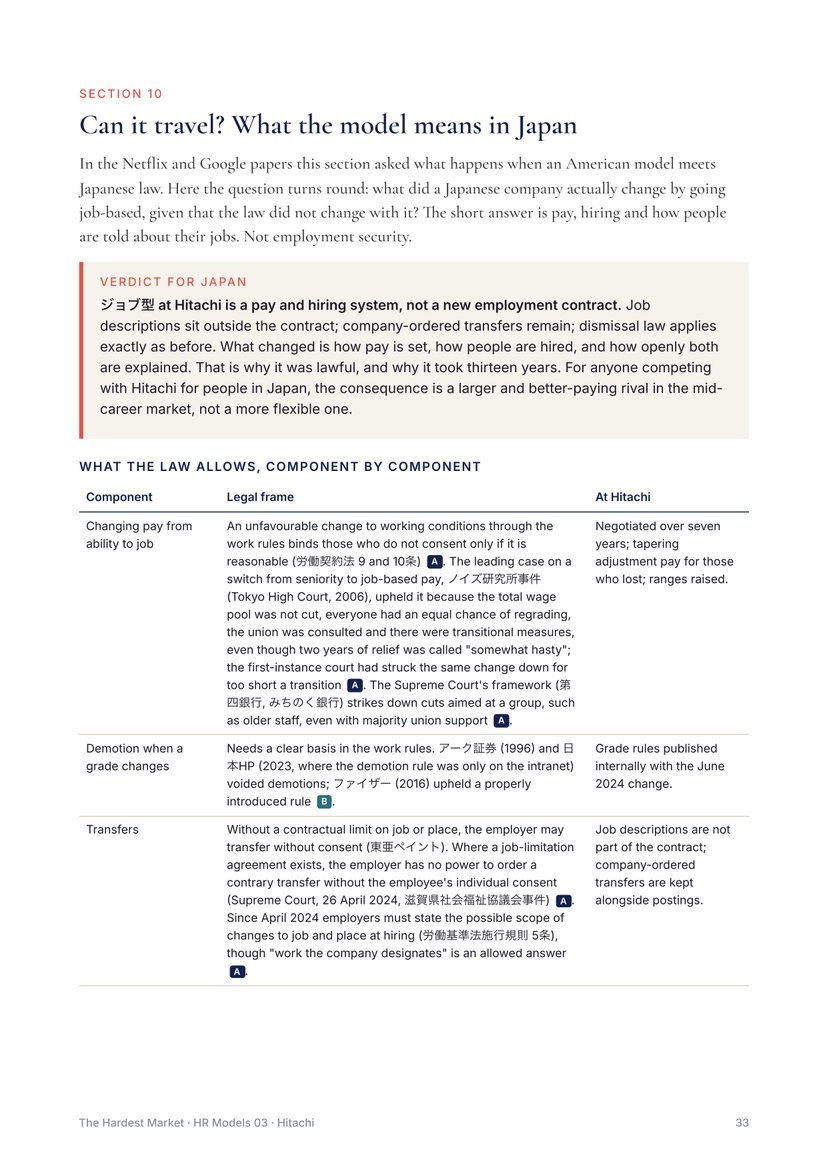
- It did not make dismissal easier, and was not meant to. Job descriptions sit outside the employment contract and company-ordered transfers remain. No early-retirement programme ran at Hitachi, Ltd. from 2008 to 2023; people left with the businesses that were sold.
What's inside
- The model piece by piece: global job grades, job descriptions, performance management, pay from ability to job, hiring, mobility, leadership pipeline, engagement and exits, with an evidence grade on every claim
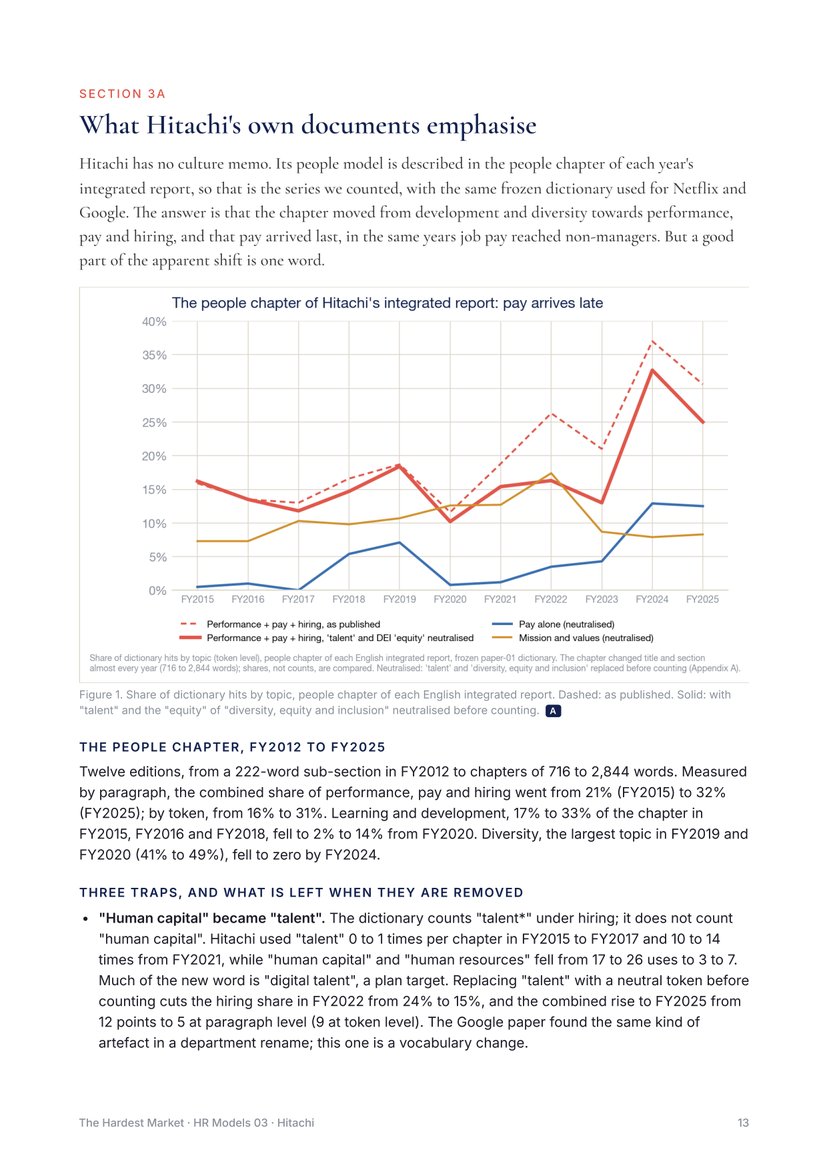
- What Hitachi's own documents emphasise, across twelve editions of its integrated report and four Codes of Conduct, counted with the same dictionary as papers 01 and 02
- Hitachi's margin, profit per employee, pay and hiring against both peer panels, FY2008 to FY2025
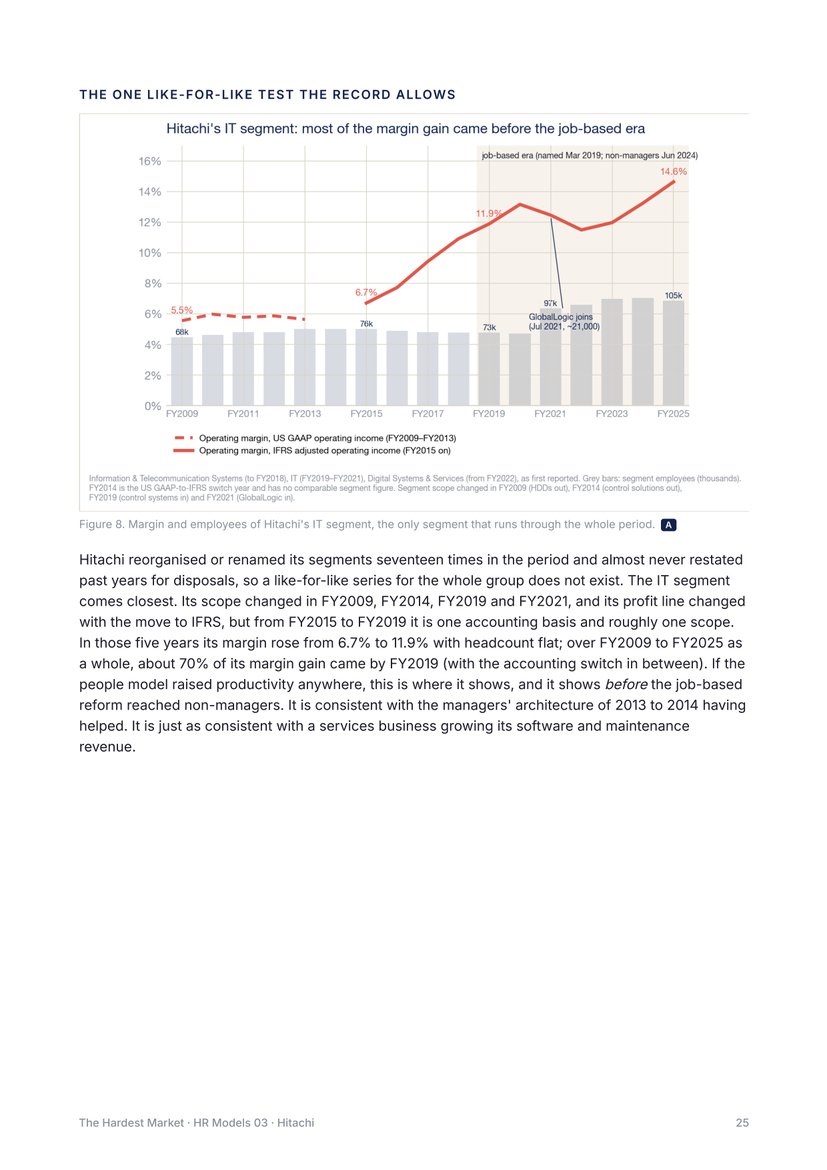
- Did the HR model drive the results, or did the portfolio? Including the one like-for-like test the record allows
- Promises kept late and promises dropped: the 2021 deadline, the 1:1 hiring target, the end of mandatory retirement
- The twenty companies in the government's 2024 job-based guide, and what happened to them
- Can it travel? What job-based HR changes under Japanese law, and what it means for companies competing with Hitachi for people
- A rollout playbook with gates and kill criteria, a scorecard, and the full text-analysis counts
Look inside
Who it is for
- Japanese companies considering job-based HRWhat Hitachi changed, in what order, with the union, and what Japanese law did and did not let it change. Why it will not make dismissal easier.
- Foreign companies hiring in JapanHitachi and its peers are now large, open buyers of mid-career talent with published pay ranges. What they offer, and what you can still offer that they do not.
- HR leaders integrating acquisitions abroadHow Hitachi bought ABB's power grids, GlobalLogic and Thales's rail signalling without rebuilding their HR, and why a common architecture mattered more than a common culture.
How we did it
We wrote down what we expected to find before reading a single filing, and kept the predictions we got wrong in the paper: all six were wrong in whole or in part. We fixed in advance how to treat gains that come only from buying or selling businesses. The text analysis uses the same dictionary as papers 01 and 02, fixed before counting. Every claim carries an evidence grade, every causal claim is tagged as correlational, a plausible mechanism, or documented, and each section ends with what it does not prove.
By Yan Sen Lu, Managing Director of Makana Partners and Editor of The Hardest Market.
Instant download. Polar handles payment, tax and the receipt. Paid newsletter subscribers get 30% off. Buying for a team? Ask for a quote.
Questions
What format is the paper, and what language?
A 52-page PDF in English, published November 2026. Japanese terms, statutes and court decisions are cited by name.
Do I need to read papers 01 and 02 first?
No. Each paper stands alone. All three use the same text-analysis dictionary, so they can be read side by side.
How do I receive it?
Polar, our payment provider, emails a download link straight after payment. You can download it again at any time from the Polar customer portal.
Who handles tax and receipts?
Polar is the merchant of record, so it charges any sales tax due and issues the receipt.
Can my team or company share one copy?
One purchase is for one reader. For a team or company-wide licence, a purchase order or an invoice, write to editor@hardestmarket.com for a quote.
Do newsletter subscribers get a discount?
Yes. Paid subscribers to The Hardest Market newsletter get 30% off. The code is in the paid-subscriber emails.
Is this affiliated with Hitachi?
No. It is an independent analysis of public sources: Hitachi's annual securities reports, integrated reports and press releases, government documents, court decisions and press reports. Hitachi did not review it.