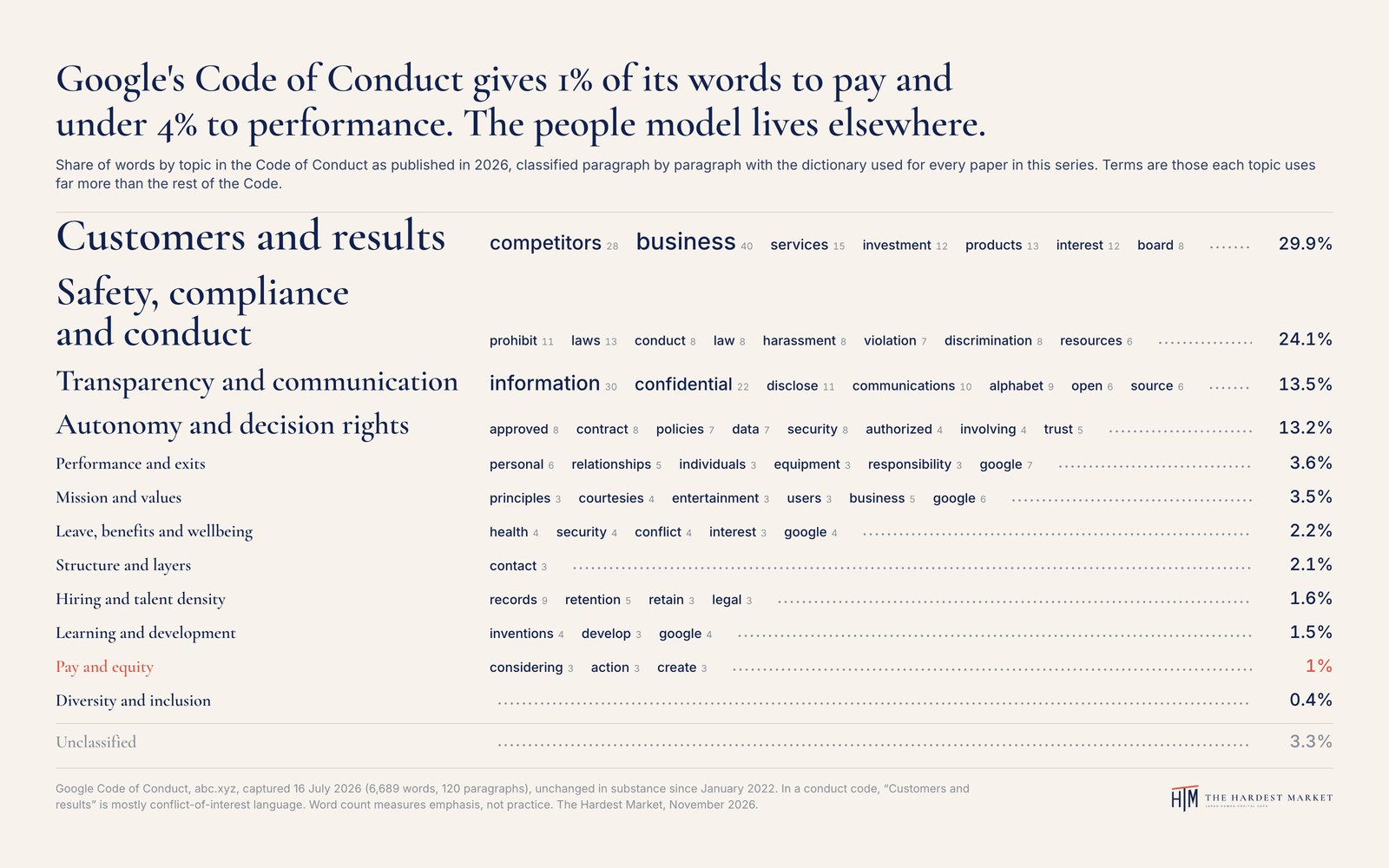
Google never wrote its people model into one public document. Its Code of Conduct gives 1% of its words to pay and under 4% to performance. The model lives in Google's published research on its own people, its hiring pages and its executives' books. This paper, published in November 2026, recovers thirteen versions of the Code from 2004 to 2026 and tests the model against Alphabet's SEC filings and against two groups of peers: the companies Google competes with for business, and the companies it hires from.
Instant download. Polar handles payment, tax and the receipt. Paid newsletter subscribers get 30% off. Buying for a team? Ask for a quote.
Verdict
Google's people model is real, unusually well documented in its own research, and consistent with the company's results. Growth paid for its generous parts, and when growth slowed they were the first to go. What travels is the measurement, not the generosity.
What the evidence says
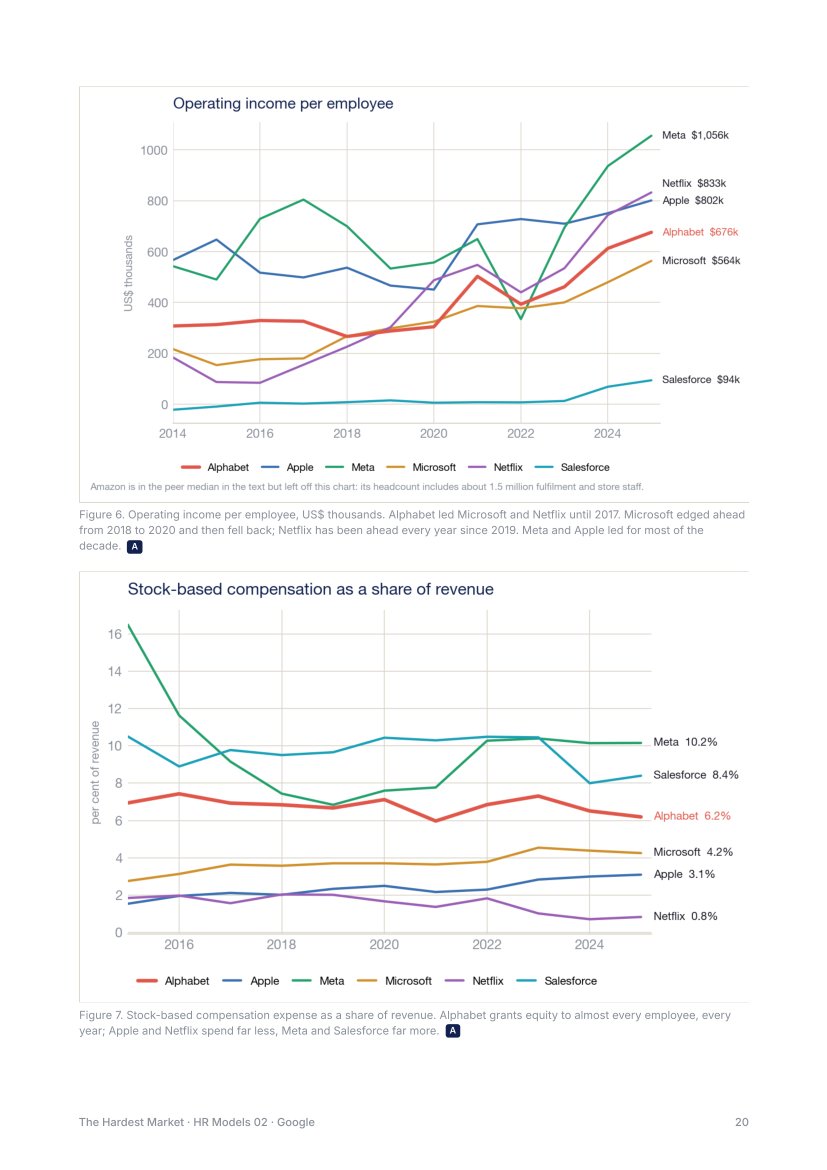
- Revenue per head is high. Profit per head is ordinary. Alphabet's revenue per employee has been above the median of the companies it hires from every year since 2014, reaching $2.1 million in 2025. Its operating income per employee sat below that median in four of the last seven years.
- Growth paid for the model, more than margin did. Operating margin fell from 35% to 19% between 2010 and 2018 while the perks stayed. The cuts came when revenue growth slowed: in 2008 and 2009, and within months of 2022, when growth dropped from 41% to 10%.
- Google reverses its own famous practices. 20% time narrowed to a fraction of staff. "Perf" was replaced by GRAD in 2022, with the share of staff expected in the lowest rating reported to rise from 2% to 6%. No company that copied a Google practice reports a financial gain from it.
- Outside shareholders said no, and the headline never showed it. Every say-on-pay vote passed, at 75% to 98%. Because the founders' shares carry ten votes each, our estimate is that holders outside the founder block voted against executive pay in 2017, 2020 and 2023.
- In Japan, the money was not the problem. The 2023 cut reached Google's Japanese company as resignation offers worth more than a typical court settlement. It still produced two unions, a damages suit, and a Tokyo Labour Commission order finding that Google had bargained in bad faith.
What's inside
- The model piece by piece: hiring committees and structured interviews, manager research, OKRs, ratings and calibration, 20% time, perks, equity for everyone and parental leave, with an evidence grade on every claim
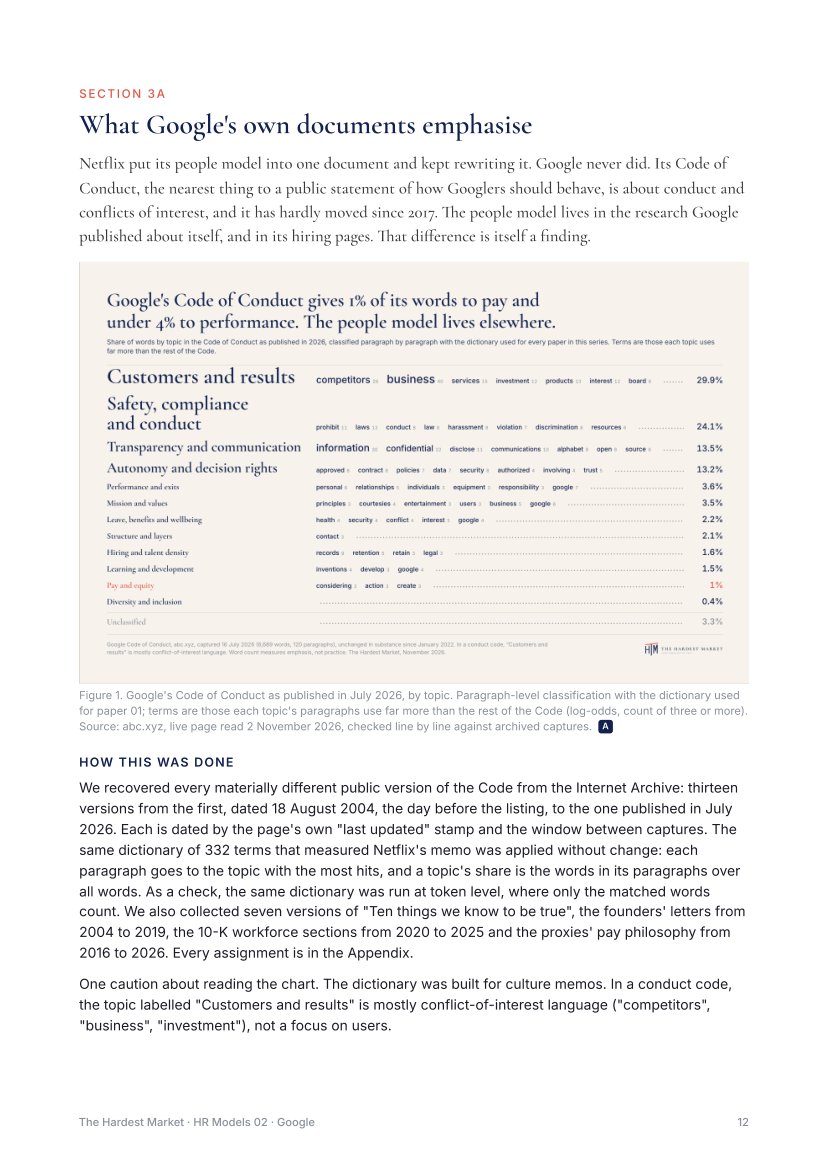
- What Google's own documents emphasise, across thirteen versions of the Code of Conduct, counted with the same dictionary as paper 01
- Alphabet's revenue, profit and stock-based pay per employee against both peer panels, 2009 to 2025
- Did the HR model drive the results, or did growth pay for it?
- Reversals and costs: the perks cuts of 2008 and 2022, 20% time, GRAD, the 2023 layoffs, and the say-on-pay votes the founders' shares hid
- The copycats, and what happened to them
- Who should copy it, who should adapt it, and who should leave it alone
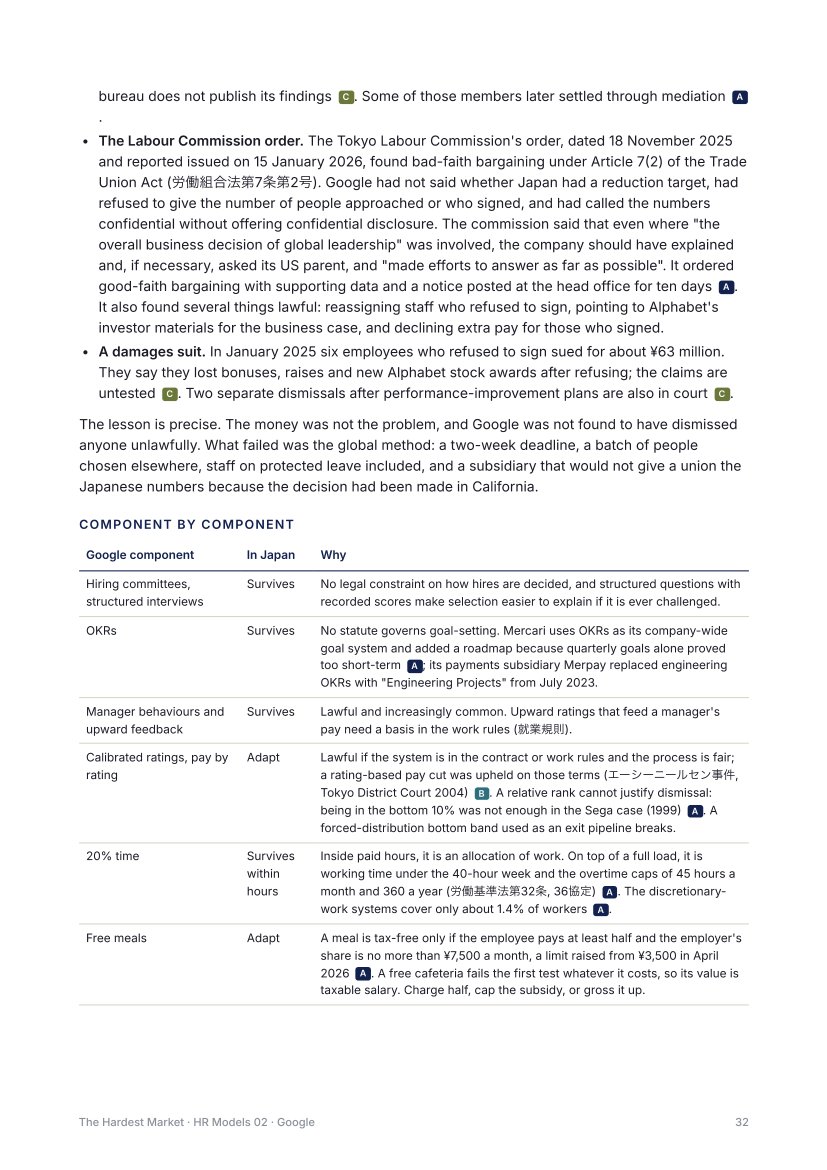
- Implications for Japan: the 2023 resignation programme, the Labour Commission order, and each component with the legal sources
- A rollout playbook with gates and kill criteria, a scorecard, and the full text-analysis counts
Look inside
Who it is for
- HR leaders asked "why can't we be more like Google?"Which parts of the model are cheap and portable, which depend on Google's growth, and what to decide in advance you would cut first.
- HR teams in Japan handed a global reduction planWhat happened when Google ran its 2023 method in Japan, what the Labour Commission said, and which Google practices survive Japanese law as written.
- Leaders building people analyticsHow Google built its research layer, from structured hiring to manager and team studies, and why its financial effect cannot be seen in public records.
How we did it
We wrote down what we expected to find before reading a single filing, and kept the predictions we got wrong in the paper. The text analysis uses the same dictionary as paper 01, fixed before counting, so the two companies are measured with the same ruler. Every claim carries an evidence grade, from audited filings to word of mouth, and every causal claim is tagged as correlational, a plausible mechanism, or documented. Each section ends with what it does not prove.
By Yan Sen Lu, Managing Director of Makana Partners and Editor of The Hardest Market.
Instant download. Polar handles payment, tax and the receipt. Paid newsletter subscribers get 30% off. Buying for a team? Ask for a quote.
Questions
What format is the paper, and what language?
A 54-page PDF in English, published November 2026. The Japan section cites Japanese employment law and the Labour Commission order by name.
Do I need to read paper 01 first?
No. Each paper stands alone. Paper 02 uses the same text-analysis dictionary as the Netflix paper, so the two can be read side by side.
How do I receive it?
Polar, our payment provider, emails a download link straight after payment. You can download it again at any time from the Polar customer portal.
Who handles tax and receipts?
Polar is the merchant of record, so it charges any sales tax due and issues the receipt.
Can my team or company share one copy?
One purchase is for one reader. For a team or company-wide licence, a purchase order or an invoice, write to editor@hardestmarket.com for a quote.
Do newsletter subscribers get a discount?
Yes. Paid subscribers to The Hardest Market newsletter get 30% off. The code is in the paid-subscriber emails.
Is this affiliated with Google?
No. It is an independent analysis of public sources: Google's own published documents, research and SEC filings, books by former executives, court and labour commission records, and press reports. Google did not review it.