The gap between the promise and the experience
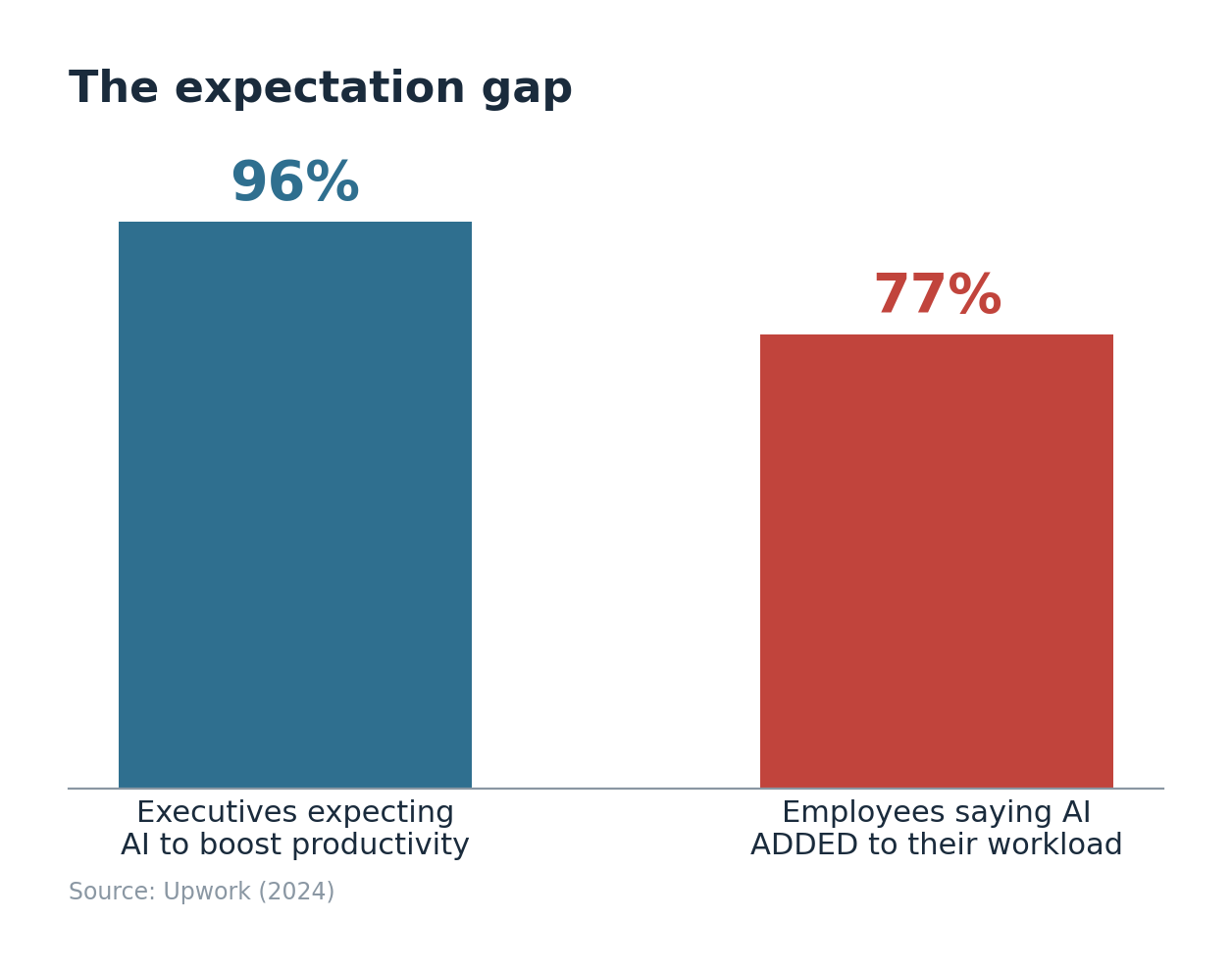
Start with the distance between what leaders expect from AI and what their people actually feel day to day. In one large Upwork study, 96% of executives said they expected AI to make their teams more productive. Almost unanimous. But when you asked the employees actually using these tools, 77% said AI had, if anything, added to their workload. Same technology, same companies — and two completely different stories depending on where you sit.
That gap is the whole ballgame. It's the difference between the view from the top, where AI looks like a lever you pull to get more output, and the view from the desk, where it often feels like one more thing to manage on top of everything else.
Japan tells the same story, only sharper
If you think that's just a Silicon Valley problem, look closer to home. Persol Research Institute ran one of the most detailed studies I've seen on this, surveying nearly 20,000 workers in Japan. And the headline number is genuinely encouraging: on the specific tasks where people used generative AI, they cut the time those tasks took by about 17% on average. That's real. That's measurable. That's exactly the kind of efficiency the technology promises.
Here's the catch. Only about one in four of those workers actually saw their total working hours go down. Read that again, because it's the crux of the whole thing. The time got saved at the task level — and then, for three out of four people, it quietly vanished somewhere between the task and the end of the day. The hours didn't shrink. They just refilled.
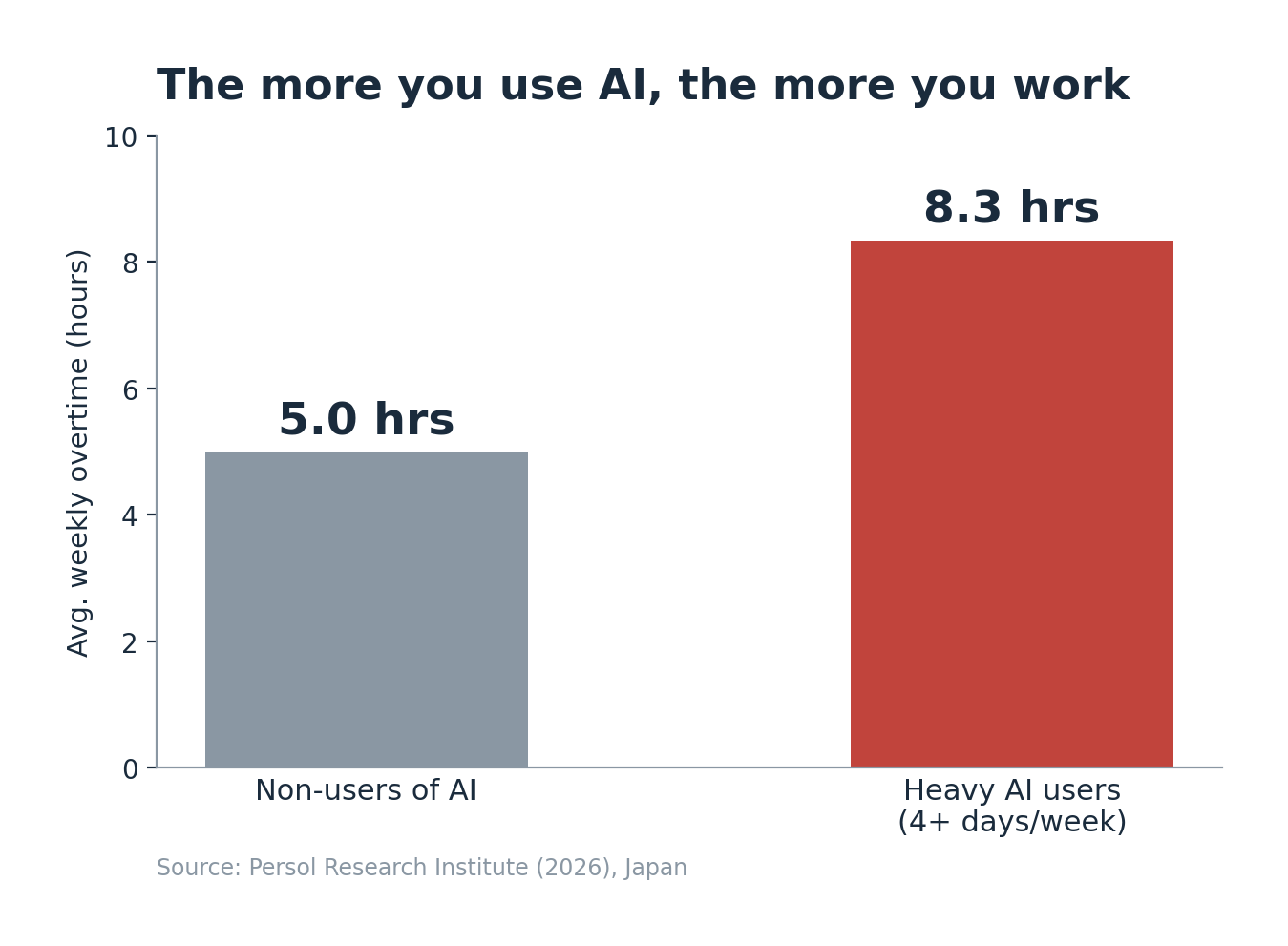
And then there's the finding that genuinely stopped me. In that same data, the people leaning into AI the hardest — the daily, heavy users — were logging more overtime than the people who barely touched it. Something like eight hours of overtime a week for the heavy users, versus around five for the non-users. The more enthusiastically someone adopted AI, the longer their days seemed to get. That is the exact opposite of what we were all promised.
So where does the time actually go?
If AI really does save time on the task, and the time doesn't show up in anyone's week, then something is absorbing it. A few things, actually, all at once.
Some of it just gets reinvested — instantly. When someone frees up an hour, it almost never turns into breathing room. It fills straight back up, usually with more of the same routine work. Save an hour on drafting, spend it on three more drafts. The finish line simply moves. In the Japanese data, most of the time people did save went right back into the job, and the bulk of it went into everyday tasks rather than the higher-value thinking we imagine AI is freeing us up to do.
Some of it creates brand-new work that didn't exist before. Researchers at Stanford and BetterUp gave this one a name that's stuck with me: "workslop." It's AI-generated output that looks finished — polished, confident, nicely formatted — but is actually thin. It's missing the judgment, the context, the "does this even make sense" check. And when it lands in a colleague's inbox looking done, they're the ones who have to notice it's hollow and do the real thinking anyway. In their research, 40% of workers said they'd received workslop in just the past month, and each instance took roughly two hours to untangle. The work didn't disappear. It got dressed up and passed downstream to whoever was paying attention.
And a lot of the time, the payoff simply never shows up where it counts. One widely-cited MIT study found that 95% of companies saw no measurable return on their generative-AI investment at all. Not a smaller return — no measurable return. The efficiency is real at the level of the individual task and strangely invisible at the level that actually matters: the bottom line, the deadline, the customer.
To be clear: this isn't an anti-AI argument
I want to be careful here, because it would be easy to read all of that as "AI doesn't work." That's not what I'm saying, and I don't believe it. AI clearly works. It genuinely speeds up screening a stack of CVs, drafting onboarding material, summarising a messy thread, getting a first version of almost anything onto the page. I use it every day. The task-level gains are real and they're not going away.
The problem isn't the tool. The problem is what we keep wrapping around the tool.
"Do more with less" treats AI as a way to shave cost off processes we designed for a world that didn't have it. So we drop a powerful new capability into an old workflow — and instead of the workflow getting simpler, it gets a whole new layer bolted on top: reviewing the AI's output, checking it for errors, cleaning up the workslop, managing the flood of extra volume the tool made possible. The time saved on the task gets eaten by the time spent supervising the task. And the two roughly cancel out.
The futurist Jacob Morgan puts it about as well as anyone: most leaders are layering AI onto their legacy processes and calling it transformation. But adoption isn't redesign. Buying the tools and telling everyone to use them is the easy part. It's also the part that quietly makes people busier.
So what actually works?
If the problem is that we're bolting AI onto old ways of working, the fix isn't more tools or louder mandates. It's design. Three things I'd focus on if I were leading through this.
First, redesign the work — don't just automate the task. Before you roll a tool out, ask a genuinely different question: what would this job look like if we'd built it from scratch assuming AI existed? Not "where can we sprinkle AI onto what we already do," but "what should the whole process even be now?" That's harder and slower, and it's the only version that actually pays off. And just as importantly — decide out loud where the freed-up time is meant to go. If you don't consciously reinvest it in something valuable — deeper customer relationships, better thinking, actually developing your people — it will refill on its own with low-value work. Saved time doesn't bank itself. Somebody has to claim it on purpose.
Second, protect quality, and measure the right thing. Set one simple rule and hold the line on it: whoever sends AI-assisted work owns it. No unchecked, unread output getting forwarded along and quietly becoming someone else's problem. That single norm kills most workslop before it spreads. And change what you measure. Stop tracking "AI adoption" — how many seats, how many prompts, how many people "using AI" — and start tracking outcomes that matter: error rates, rework, quality of hire, time-to-value, customer satisfaction. Chasing adoption for its own sake is exactly how companies end up in that 95% with nothing to show for it.
Third, point people at higher-value work — and actually train them to do it. As AI absorbs the routine, the human roles that win are the ones built around judgment, relationships, and orchestrating the tools well. But you can't just announce that shift and expect it to happen. A striking share of workers say they honestly don't know how to get the productivity gains they're being asked for — the tool landed on their desk with a mandate and no map. So invest in the training. Reward good work, not just fast work. And resist the temptation to treat AI purely as an excuse to cut headcount, because the moment you do, everyone left standing learns that "efficiency" is just code for "do the work of the people who left."
Why this matters more here than almost anywhere
Everything above is true in any market. But it lands differently in Japan, and I think leaders here need to sit with that.
This is the hardest market. Good people are genuinely scarce, the demographics are only tightening the squeeze, and once you've got strong performers, keeping them is close to everything. In that environment, quietly piling invisible AI overhead onto your best people isn't a clever productivity play. It's a retention risk. Your most capable, most engaged employees are exactly the ones who'll lean into AI hardest — and, per that Japanese data, exactly the ones most likely to end up working the longest hours as a result. You can burn out your best people while congratulating yourself on how "efficient" the team has become.
And in a market where replacing someone is slow, expensive, and sometimes simply not possible, that's not a soft cost. It's one of the most expensive mistakes you can make.
The companies that come out ahead in this next stretch won't be the ones that adopted AI the fastest or bought the most licenses. They'll be the ones honest enough to tell the difference between looking productive and being productive — and disciplined enough to redesign the work rather than just pile the tools on top of it.
Because "do more with less" isn't a strategy. It's a slogan. The real work — the work that actually pays off — is the redesign.
Sources
Upwork (2024); Persol Research Institute (2026); Stanford Social Media Lab & BetterUp / Harvard Business Review, "Workslop" (2025); MIT (2025).